A full service day on one phone — from open to day-close.
Yes — one Android phone and one thermal printer will run a small restaurant end to end: table orders, KOTs, GST bills, cash and UPI, and the shift's cash count. That product is the Android phone register. This guide is the other half of the answer — what a whole service day actually looks like on it, and where it stops working.
Reading this on a phone? See the Android phone register — a whole restaurant, one phone · iPhones print on Wi-Fi too · works offline
A phone, a printer, and your own Wi-Fi.
- One Android phone. The till phone should be Android — it keeps printing with the screen off. An iPhone takes orders, marks payments, and prints to a Wi-Fi printer while the app is open, but iOS pauses printing in the background.
- One thermal printer. Bluetooth Classic, paired once in Android's own Bluetooth settings, or Wi-Fi/TCP — type the printer's IP, port 9100. 58mm or 80mm paper, your choice. EasyKOT speaks ESC/POS, the standard these printers use; the honest check is always the test print, not a compatibility list.
- Your own Wi-Fi. Not for us — for the printer, and for any waiter phones you add later. The billing itself does not need the internet.
- No cash drawer. There is no drawer to kick from a phone. What replaces it is a cash box on the Device tab — float in, paid-outs with a reason, and a count at the end.
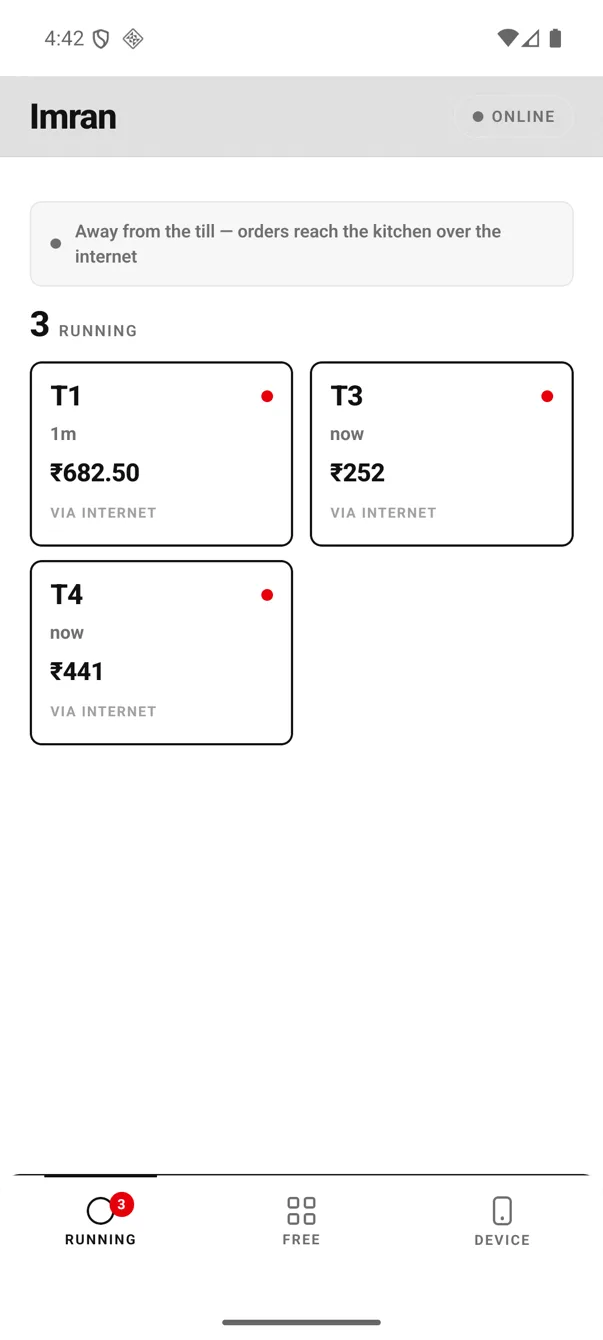
A phone-only store has no kitchen display. The phone's print server publishes no KDS tickets, so a phone-only kitchen is a printer kitchen — paper, not a screen. If you want tickets on a screen, that needs a register on the counter.
Enrol the phone as a Register — not a Captain.
In the owner dashboard, Devices → Add device asks what kind of device this is: Register (Desktop till), Captain (Waiter phone) or Kitchen display. If this phone is going to be your till, choose Register — even though it is a phone. That kind is what carries your GST invoice series.
The kind is fixed the moment the setup code is minted and cannot be changed afterwards. A phone enrolled as Captain prints un-numbered bills — which is not a GST tax invoice. If you picked the wrong kind, mint a fresh setup code with the right one; there is no switch to flip later.
- Then turn printing on. The phone asks "Make this phone the store's printer?" and wants a manager PIN. Turning it off again is one tap and deliberately ungated — stopping the printing should never need a manager during a rush.
- Add the printer. Bluetooth is paired in Android's own Bluetooth settings first, then picked up in the app; Wi-Fi printers take an IP and port 9100. Step by step: pair a Bluetooth thermal printer to an Android phone.
- Say what it prints. Each printer on the phone has a Prints setting — Everything, KOTs or Bills. One printer doing everything is the normal phone-only setup.
- Run the test print before service. It is the only honest proof that this printer, this cable-less link and this paper width work together. If the layout is cut off, switch 80mm to 58mm and print it again.
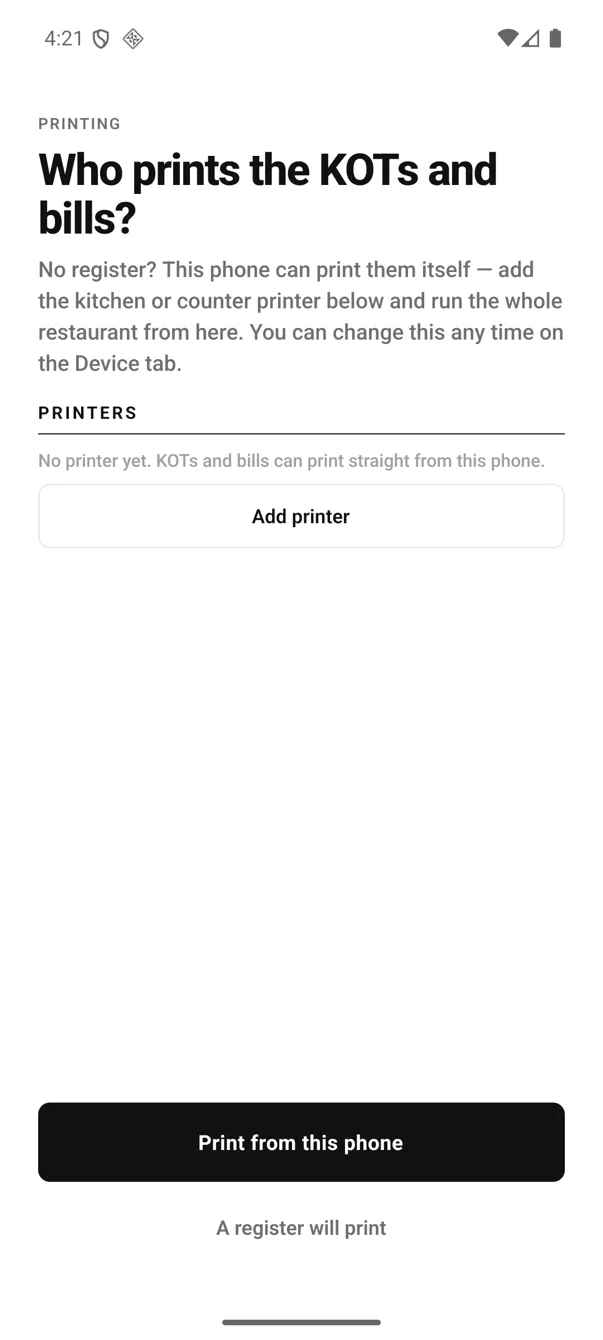
The printing decision, asked during setup — pick "Print from this phone" here.
Morning: the float goes in the box.
The cash box lives on the Device tab, and the app opens the day the way a cashier would: Start the day by putting the float in the box. Type what you actually put in — ₹2,000, ₹500, whatever the drawer holds — and the shift is open. It is gated by the cash permission, so on a phone a captain is asked for a manager PIN; the owner is not.
Menu changes come down on their own. Anything you edited in the dashboard last night — a price, a new dish, a portion — is on the phone by the time you open. Nothing to import, nothing to press.
Lunch: the same phone takes the order and prints the KOT.
Table 4 from the Free tab, dishes from the menu, portions and notes where they matter, then Fire. Because this phone is the printer, the ticket does not travel anywhere — it goes straight down the Bluetooth link to the kitchen printer. The taps are identical to a waiter's: how a waiter takes an order and fires a KOT.
- It keeps printing with the screen locked. An Android foreground service does the work, and its notification reads "EasyKOT is the printer" / "KOTs and bills print from this phone". That permanent notification is expected — do not swipe it away, and do not let a battery optimiser kill it.
- Paper never blocks a sale. Every ticket is a durable job in the phone's own database. The sale is written first, the print is queued second, and a failed job retries on its own — after 5 seconds, then 15, then 45, then every 45 — until the printer comes back and the queue drains itself.
- Round two prints only the new items. A second fire carries just what was added, headed Round 2+ with the previous count, so the kitchen never cooks the first round twice.
The bill: a proper GST invoice, then cash or UPI.
- A numbered tax invoice — because the phone was enrolled as a Register. Your GSTIN, the invoice series, CGST and SGST on their own lines, round-off. A reprint keeps the same invoice number and date and is stamped as a duplicate copy, with a record of who asked for it.
- Settling from the phone is marking, not taking. Cash and UPI only. No drawer opens, no card is read. If you take cards, the machine stays a separate machine and you mark the payment here.
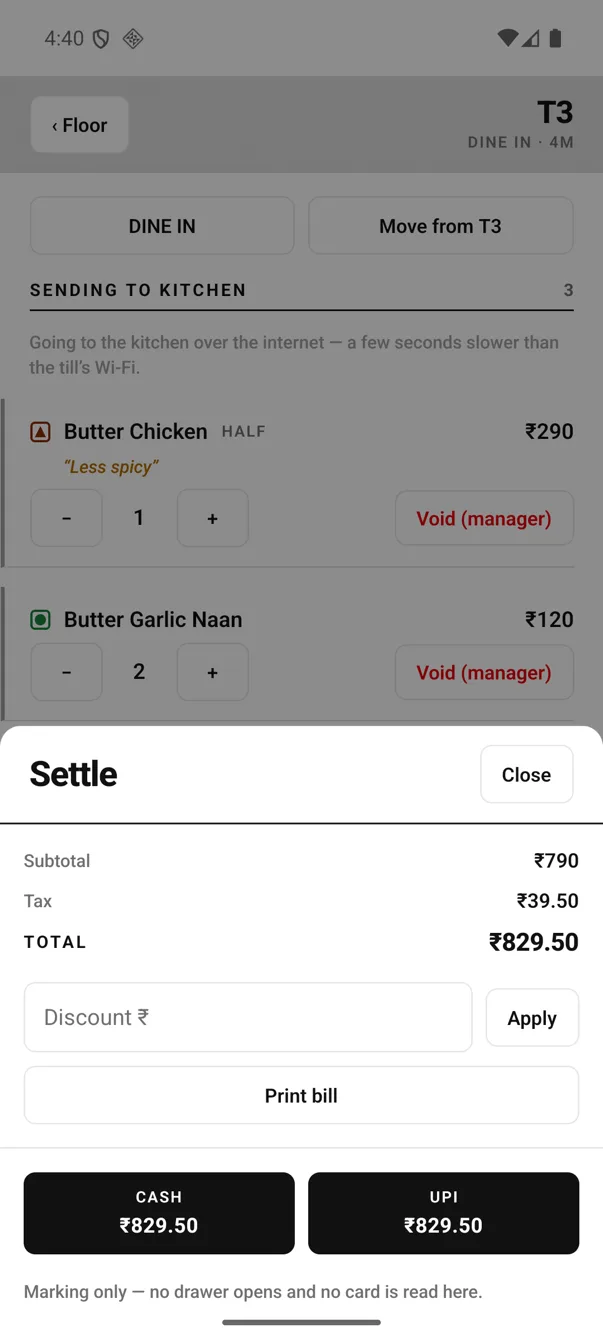
Cash or UPI — the footer says exactly what marking is and is not.
- Paper width is a layout, not a label. 80mm gives you 42 characters per line, 58mm gives 32 — which is why a bill that looks cut off is usually a width setting, not a broken printer.
- Printed money reads "Rs." The ₹ sign does not exist in the ESC/POS character sets thermal printers use, so the slip says Rs. That is deliberate, not a bug — it is the same on every thermal printer you have ever been handed a bill from.
Step by step, from a punched order to the printed slip: make your first GST bill on EasyKOT.
Adding a second phone.
The next phone is not a second till — it is a waiter's phone, enrolled as Captain, taking orders that come back to this one to print. There is no per-waiter or per-phone charge, so adding hands costs nothing but the enrolment.
One thing to know before you do it. A phone cannot host the LAN hub — that is a desktop register's job. So captain phones in a phone-only shop reach the printing phone over the internet rather than the one-hop path on your own Wi-Fi: a few seconds instead of about one, and it needs the connection to be up. It works; it is just not the fast road.
The enrolment itself is the same two codes as any waiter phone — set up the captain app on a waiter's phone.
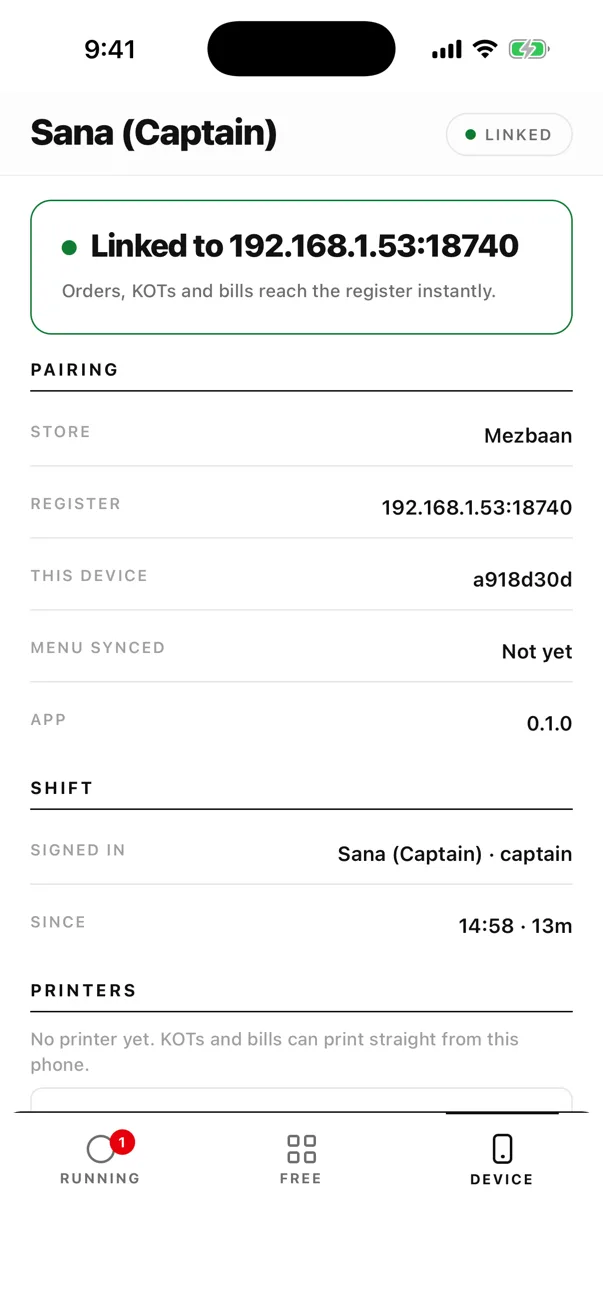
The waiter phone's own Device tab — linked to this one, its own shift, and no printer of its own.
Evening: count the box, close the shift.
Back on the Device tab: the box shows the Float you put in, the cash it counted from the day's settles, any paid-outs you recorded (each with its own What for? note — "vegetables", "gas"), and Should be in the box. Then Count & close shift: you type what is actually there, and the app tells you the variance instead of making you work it out at midnight.
- It closes a shift, not a calendar day. A place that runs lunch and dinner as two shifts closes twice, and each close stands on its own. That is the honest unit — a day boundary at midnight has never matched how a restaurant actually hands over cash.
- UPI is counted separately from cash, so "should be in the box" means notes, not turnover.
- The owner sees it wherever they are. Whenever the phone next has a connection, the day pushes up to the dashboard — sales, orders, average order, and the close.
When you should add a laptop.
A phone-only shop is a real setup, not a demo — but it has edges, and you should know them before service teaches you. None of these are things we plan to argue away.
- Two people cannot bill at once. One phone is one queue. The moment a cashier and a waiter both want the till, the phone becomes the bottleneck.
- No kitchen display. A phone's print server publishes no KDS tickets. Phone-only kitchens are paper kitchens.
- No USB or serial printers. A phone drives Bluetooth and network printers only. If the printer you own is a USB one, it belongs on a register.
- No LAN hub. Captain phones cannot take the fast one-hop path to a phone; they go over the internet instead.
- No cards, no refunds from the phone. Cash and UPI marking only.
- A long menu on a small screen. Forty dishes is comfortable. Three hundred, at 8pm, with a queue at the counter, is where a laptop's grid starts winning by seconds a ticket.
- One device is one point of failure. Keep it on a charger, and enrol a second device before you need it — not during the rush where you discover you needed it.
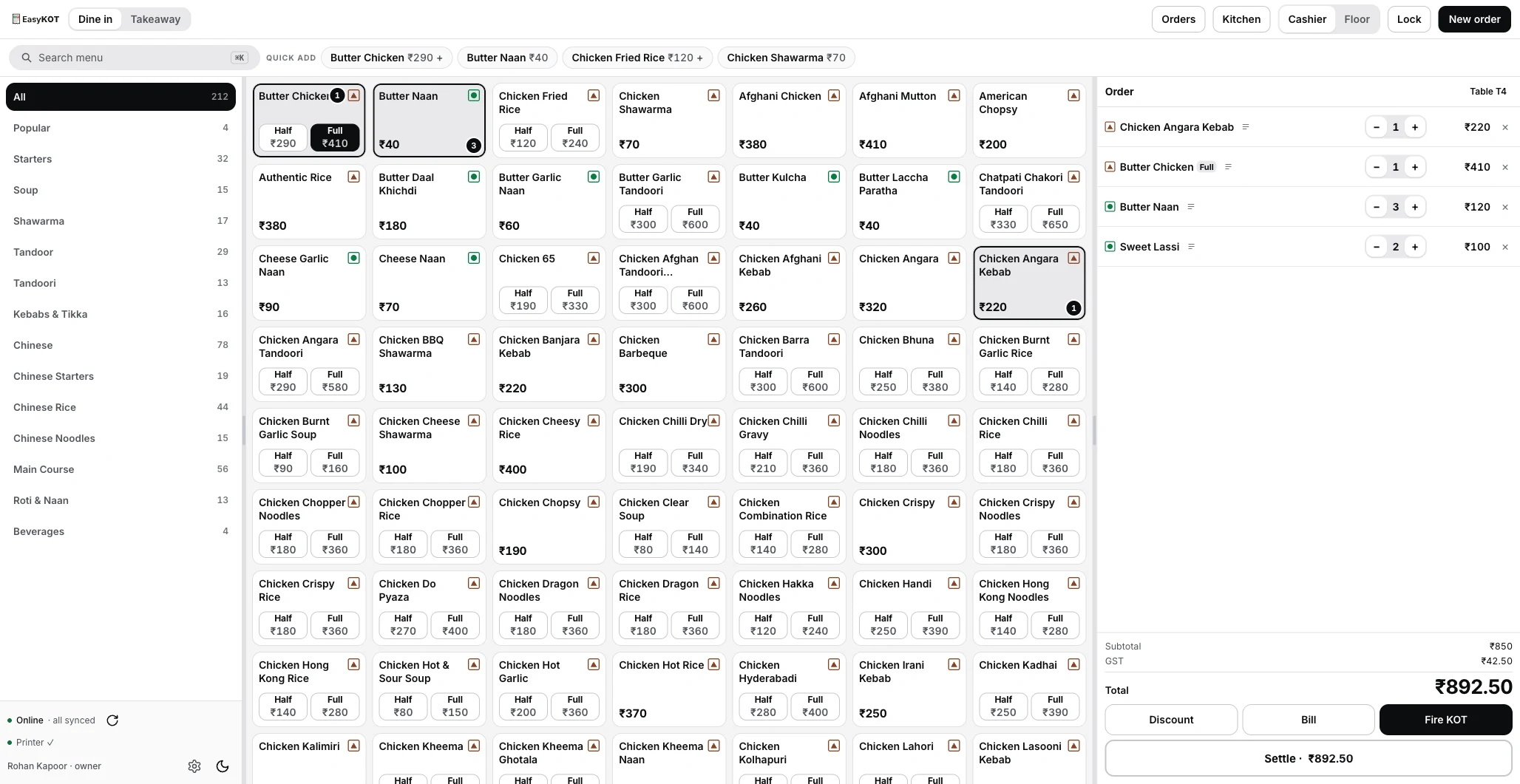
What a counter laptop adds: a full menu grid and the check side by side, and a second person able to bill.
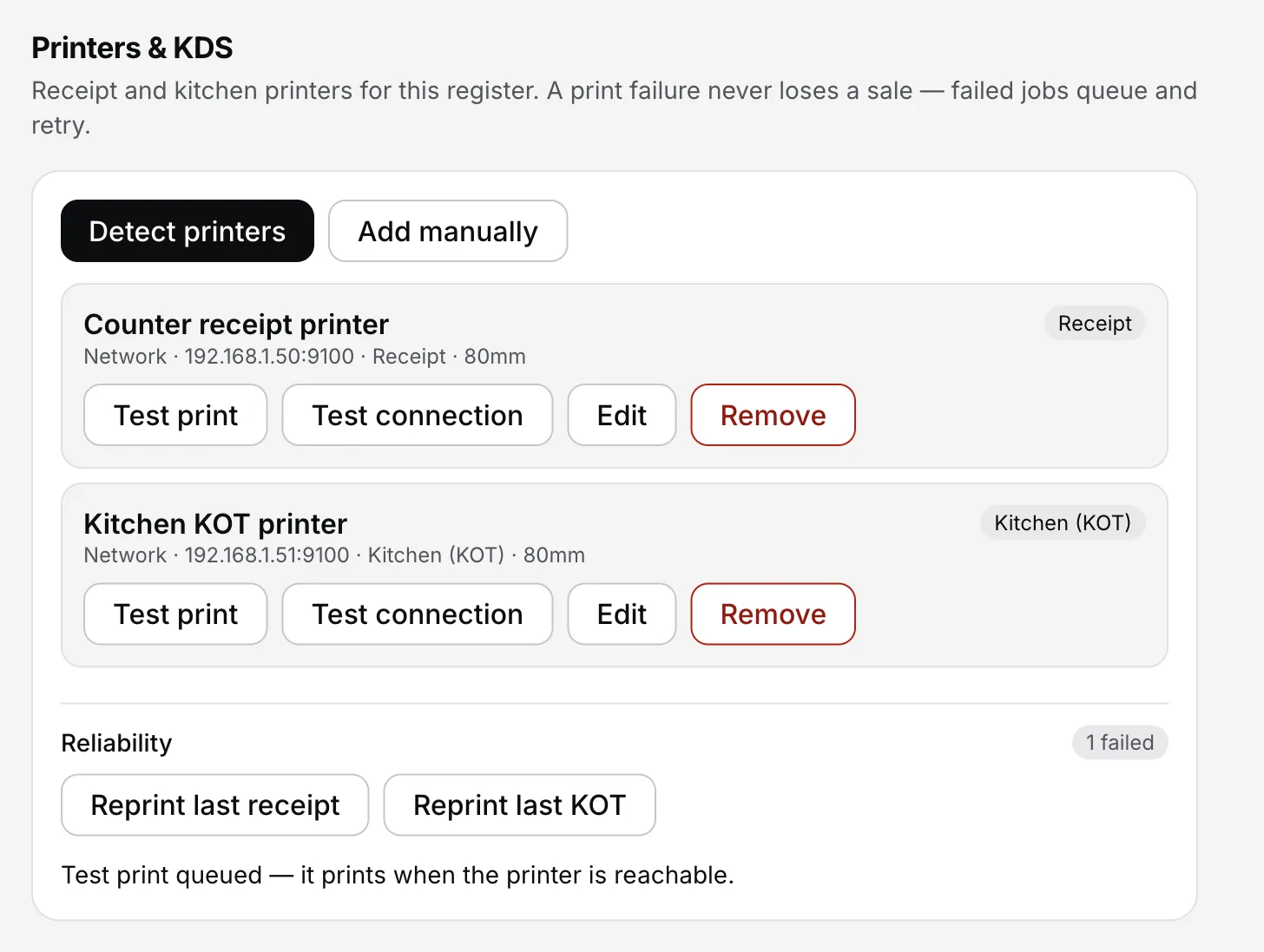
Settings → Printers & KDS on the desktop register — two printers, each with its own role, plus the reliability panel. The phone has printer roles too, worded "Prints": Everything / KOTs / Bills.
Adding the laptop later costs nothing extra. Same account, same ₹299/month, same store — the desktop register for Windows or Mac signs in with a connect code and picks up your menu, tables and history. Nobody has to re-key anything. The register's own case is on the billing page.
On a laptop already? Try the register in the browser — it is the real till, and it needs a laptop-size screen, so on a phone the nearer door is the Android phone register.
Straight answers.
Can one phone really run a whole restaurant?
How many tables before I need a laptop?
Which phone is good enough?
Does it work without internet?
Can I add a laptop later without losing my data?
Can I make a GST bill without a laptop?
What happens if the phone breaks?
Next: pair the Bluetooth thermal printer, add a waiter's phone with two codes, or read the product case on the Android phone register.
Run it 3 months, then pay for it.
Three months free, full product, no card. Made in India, for the counter — built inside a running restaurant.