EasyKOT, a restaurant POS for Singapore, worked through one real check.
This post follows one dine-in check at a sample Singapore restaurant through EasyKOT: four dishes and drinks, a 10% service charge, 9% GST and a 10-cent bottle deposit. It shows what the register, the printed receipt and the owner's export say, which IRAS or NEA rule each line answers, and what EasyKOT does not do yet.
EasyKOT in Singapore, at a glance
EasyKOT is a restaurant point-of-sale (POS) system for Singapore restaurants, cafes and hawker stalls that keeps billing offline, prints receipts with 9% GST, the service charge and the 10-cent BCRS drink deposit on separate lines, and costs S$9 a month or S$90 a year after 3 free months.
| What it is | Restaurant POS: register, kitchen tickets (KOT), captain app for waiters, kitchen display and an owner dashboard |
|---|---|
| Price | S$9 a month or S$90 a year, paid once per period, no automatic renewal; first 3 months free, no card |
| GST | 9%, with menu prices entered including or excluding GST; registration number on every receipt; works for stalls not registered for GST |
| Service charge | Any percentage, dine-in and/or takeaway, GST charged on it; can be waived on one check |
| Drink deposit (BCRS) | 10 cents per covered plastic bottle or can on its own line, outside GST; Return Right F&B outlets can mark containers kept at the table |
| Offline | Billing, printing, payments and refunds keep working without internet and sync later |
| Runs on | Windows or Mac Desktop App, a browser, and Android phones for waiters; ESC/POS thermal printers |
| For the accountant | Singapore GST records export (Excel or CSV): each bill and refund with GST, service charge and deposit in separate columns |
| Payments | Cash, PayNow and card at the register; cash and PayNow on a waiter's phone. PayNow and card are marked by the cashier: the guest pays your own PayNow/SGQR code or your bank's terminal |
| Not yet | No PayNow QR with the amount shown by the till, no card-terminal link, no 5-cent rounding, no full tax invoice with the customer's details, not an InvoiceNow-Ready Solution |
It suits
- A single restaurant, cafe, hawker or coffeeshop stall, GST-registered or not
- Outlets that want billing and kitchen tickets to keep working when the internet drops
- Owners who want a low fixed price with no contract and their own printer and laptop or PC
It is not the right choice yet for
- Outlets that need the till itself to show a PayNow QR with the amount, confirm the transfer, or run card payments
- Outlets that need GrabFood or foodpanda orders inside the POS
- Businesses that need the POS to send InvoiceNow data to IRAS, or a full tax invoice with the customer's name and address
- Buyers who need a government pre-approved grant solution: EasyKOT is not on a Singapore pre-approved list
Keeps working without internet
- Ringing orders and sending kitchen tickets to printers and the kitchen display on the same Wi-Fi
- Waiters' Android phones on the same Wi-Fi
- Printing bills and receipts, with their numbers
- Recording cash, PayNow, card and part payments (the transfer or card approval happens on the guest's phone or your bank's terminal)
- Refunds, the service charge waiver and the bottle deposit
Needs internet
- The owner dashboard, reports and the GST export
- Setting up a new device for the first time
- Syncing with devices that are not on the same Wi-Fi; the Desktop App must sync at least once every 30 days
| Subscription | S$9 a month or S$90 a year, paid once per period; first 3 months free, no card |
|---|---|
| Contract or setup fee | None; nothing renews by itself |
| Per-order or per-device fees | None from EasyKOT |
| Hardware | Your own Windows PC, Mac or browser device, Android phones for waiters, and an ESC/POS thermal printer; EasyKOT does not sell hardware |
| Card fees | Charged by your bank or card-terminal provider, not by EasyKOT |
What a Singapore F&B bill has to get right
Five rules shape a restaurant bill in Singapore today. Each comes from an IRAS or NEA page we read on 4 November 2026; the links are below each point.
- GST is 9% on standard-rated food and drink, for a business registered for GST (IRAS: responsibilities of a GST-registered business).
- GST applies to the service charge too. IRAS’s own example: S$100 of food, a S$10 service charge, then 9% GST on S$110, for S$119.90 (IRAS: hotel and food & beverage).
- Menu prices include GST, with one exception: an outlet that charges a service charge may show prices before GST if it displays a prominent statement such as “Prices are subject to GST and service charge” (IRAS: displaying and quoting prices).
- Every receipt carries your GST registration number. For a bill up to S$1,000 a simplified tax invoice is enough: your name and address, GST registration number, date, an invoice number, what was sold, the total including GST, and a statement like “price payable includes GST” (IRAS: invoicing customers).
- Drinks in plastic bottles and cans carry a 10-cent deposit since 1 April 2026, under the Beverage Container Return Scheme: pre-packaged drinks in plastic or metal containers from 150 ml to 3 litres (glass, cartons and drinks made on the spot are not covered). The deposit is not subject to GST. A receipt need not show it, but if it does, IRAS asks for it on its own line, marked as not subject to GST (IRAS: GST and BCRS deposit).
A register that gets these right has to split every bill four ways: food, service charge, GST and deposit. The rest of this post shows that split on one check.
S$22.54, line by line
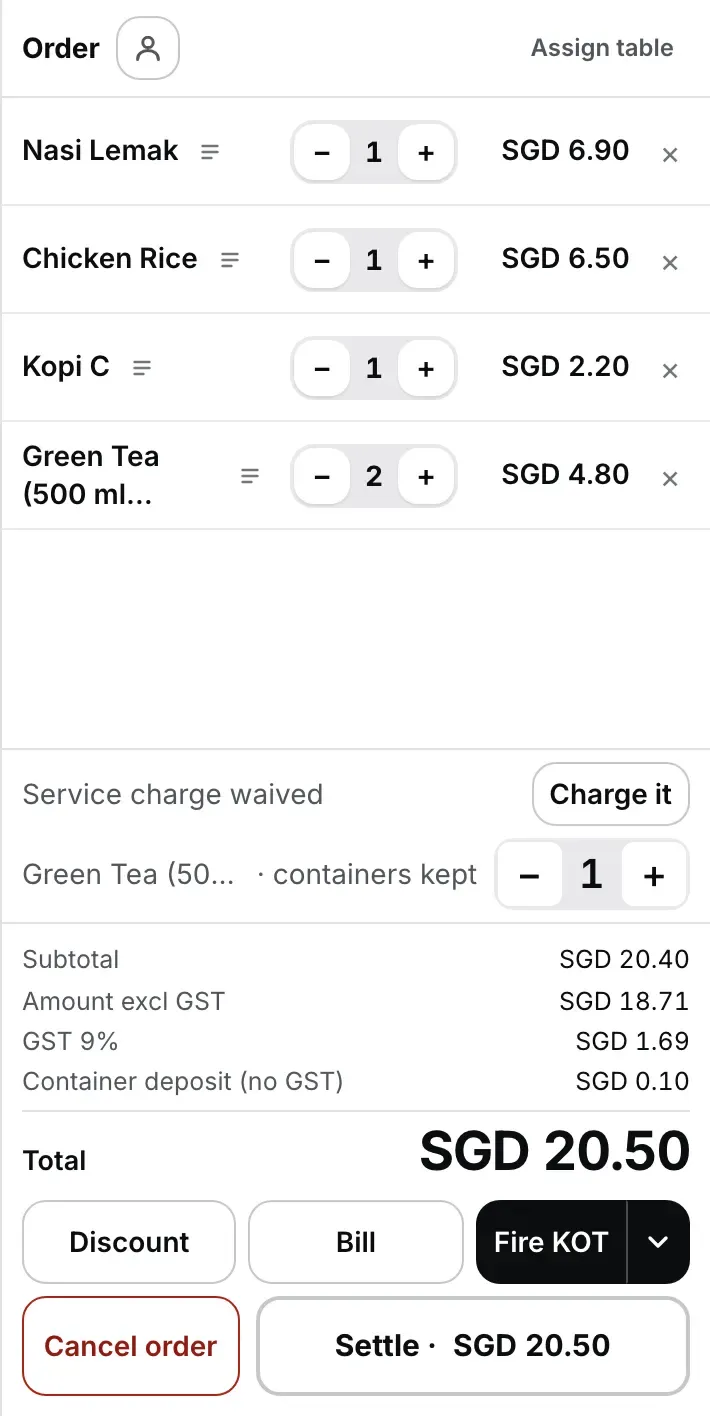
Kampong Kitchen is a sample GST-registered restaurant: menu prices include GST, a 10% service charge applies to dine-in, and the outlet is in the Return Right F&B Scheme. Two guests order a Nasi Lemak (S$6.90), a Chicken Rice (S$6.50), a Kopi C (S$2.20) and two 500 ml bottles of green tea (S$2.40 each).
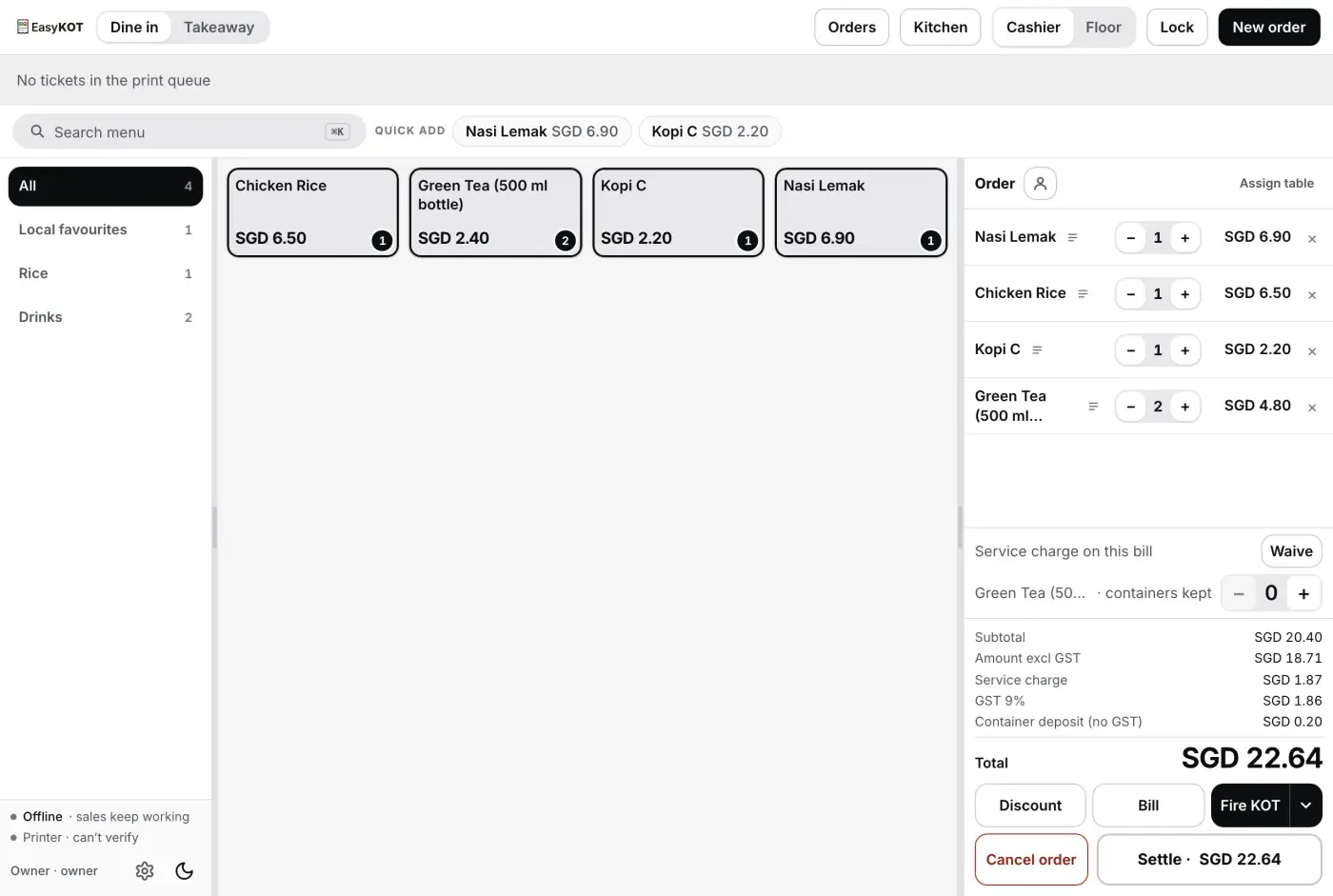
Because the menu prices include GST, EasyKOT first takes GST out of each dish: S$20.40 on the menu is S$18.71 before GST. The 10% service charge is worked on that S$18.71, which gives S$1.87. GST is then 9% of food and service charge together: S$1.69 on the food plus S$0.17 on the service charge, S$1.86 in all. The deposit is added last and never taxed.
| Line on the bill | Amount |
|---|---|
| Menu prices (include GST) | S$20.40 |
| Amount excl GST | S$18.71 |
| Service charge, 10% | S$1.87 |
| GST 9% on food and service charge | S$1.86 |
| Container deposit, one bottle (no GST) | S$0.10 |
| Total | S$22.54 |
The guests left one bottle at the table and took one with them, which is why the bill carries one 10-cent deposit and not two. The next sections show where that choice is made.
What the receipt prints, set against the IRAS list
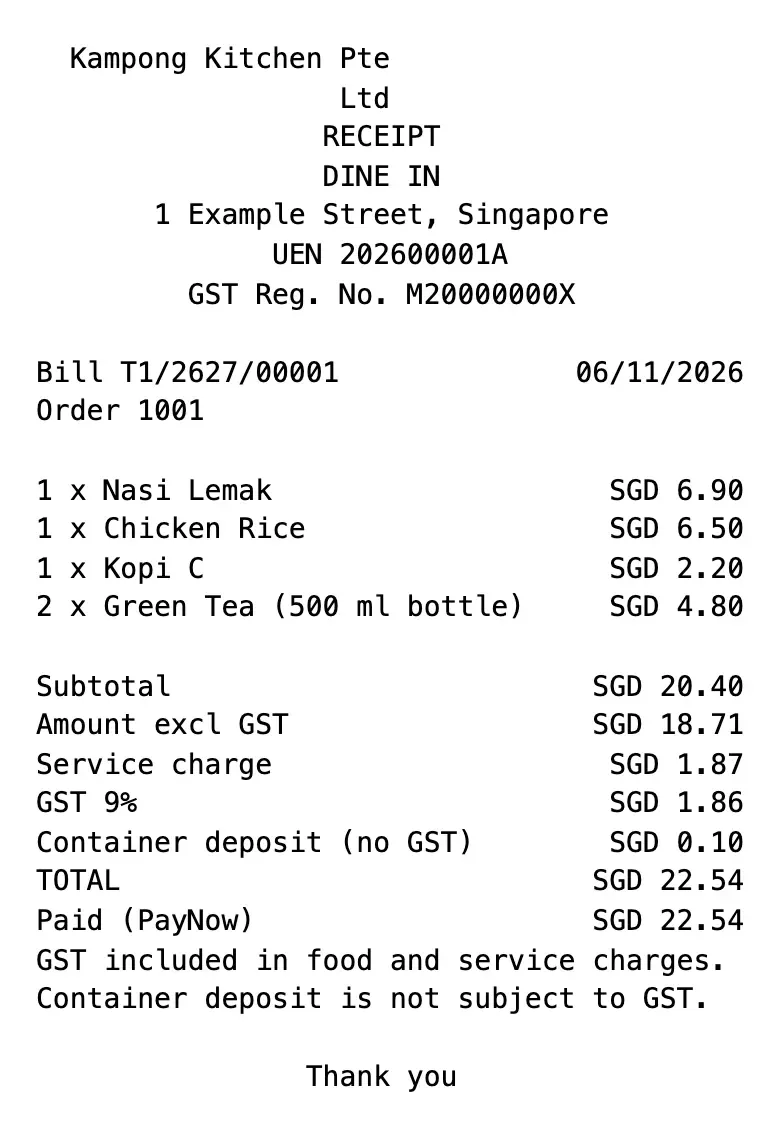
Going down the IRAS list for a simplified tax invoice, line by line:
- Name and address: Kampong Kitchen Pte Ltd, 1 Example Street, Singapore, with the UEN under it.
- GST registration number: “GST Reg. No.” and the number, on every receipt.
- Date and invoice number: 06/11/2026 and Bill T1/2627/00001, numbered on the register even offline.
- What was sold: each dish and drink with its quantity.
- Total including GST, and the GST amount shown on its own.
- The statement: “GST included in food and service charges.”, and for the deposit, “Container deposit is not subject to GST.”
We built the receipt from that list, but we are not your tax adviser. Show a receipt to your accountant before your first service, and tell us if they want something changed.
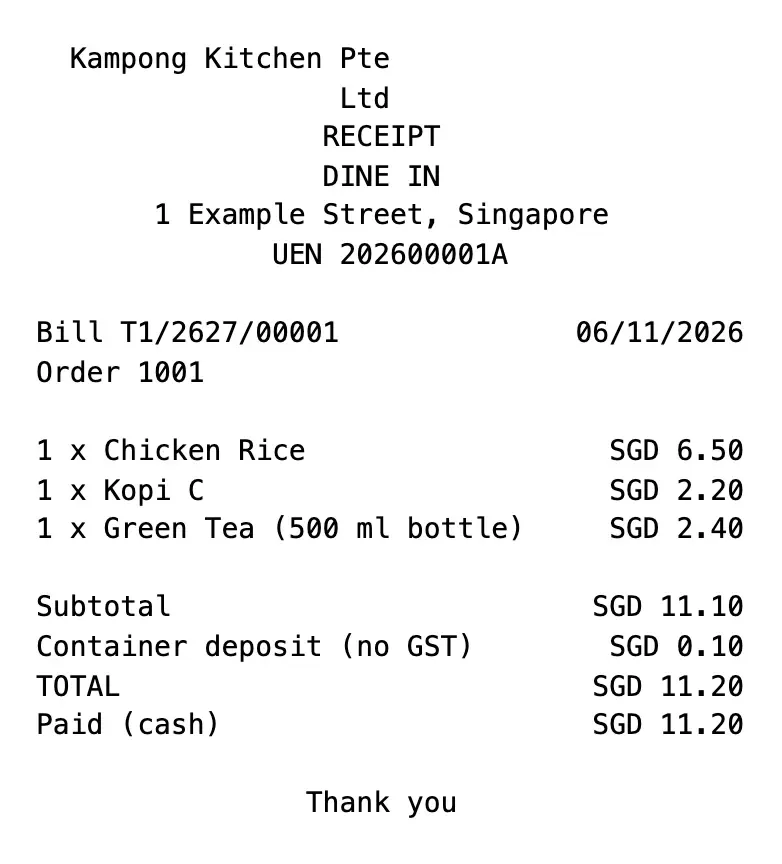
A stall that is not registered for GST gets a shorter receipt: no GST lines and no registration number, only the prices, the deposit and the total.
The 10-cent deposit, and what Return Right outlets do differently
NEA describes two kinds of outlet. An outlet outside the scheme below (NEA names hawker centre stalls and most coffeeshops as likely examples) charges the 10-cent deposit on every covered drink, and the guest gets it back at a Return Right machine. An outlet in the Return Right F&B Scheme (RRFS) collects the empty containers itself and charges no deposit for drinks finished on the premises; takeaway drinks still carry it (NEA: for F&B operators).
In EasyKOT the owner ticks which drinks carry the deposit, once, in the menu. If the outlet is in RRFS, a dine-in check shows a “containers kept” counter for each of those drinks. Here the cashier set it to one of two, so one deposit left the bill.
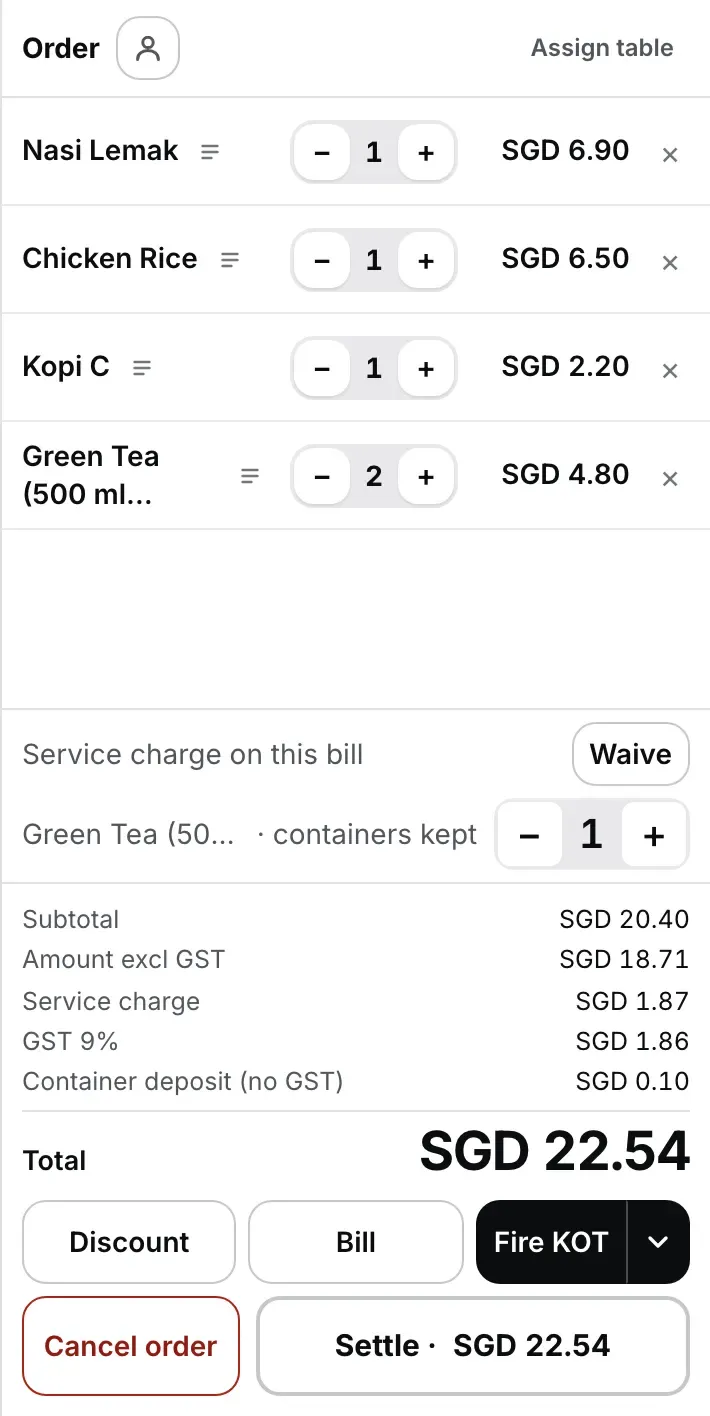
The service charge can be waived on a single check from the same panel, for example when a regular sits at the counter. Waive removes it and the GST on it in one tap; Charge it puts both back. A cashier or manager can do this, and the check records who did.
A refund where the bottle does not come back
Later the guests ask for a refund. On the Orders screen, a refund asks for two things: the amount typed again, and how many bottles came back. The guest did not bring back the bottle they took, so the cashier sets “Containers returned” to zero and its 10 cents stays with the restaurant. The refund is S$22.44, and a manager signs for it with their PIN.
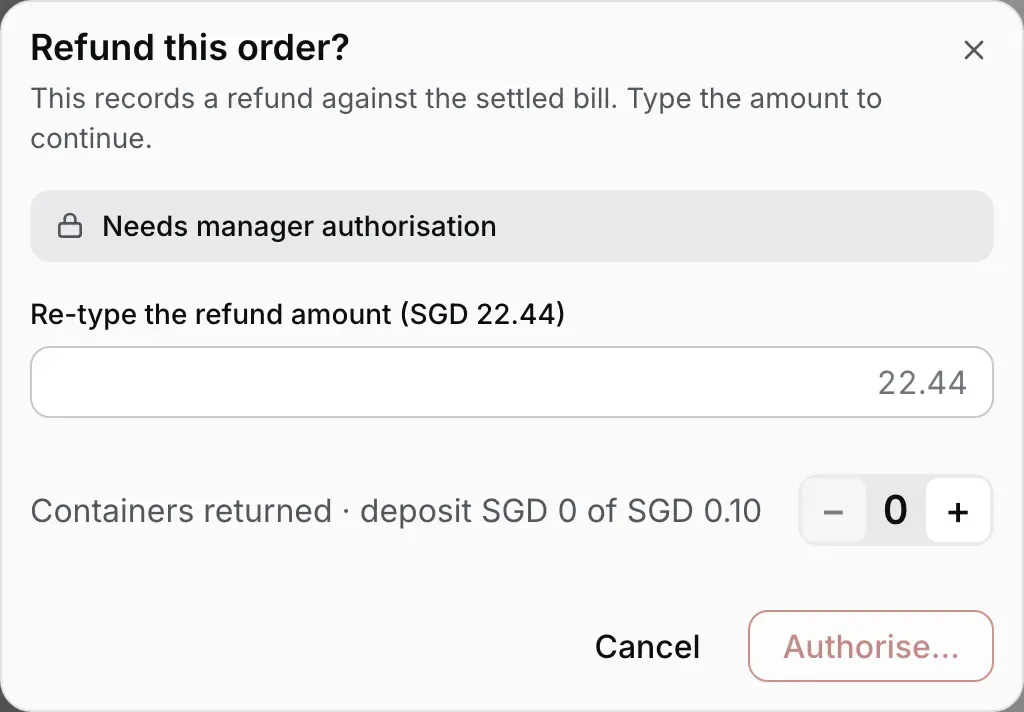
The GST on the food and the service charge is credited in full, and the deposit is not, because no GST was charged on it. If two tills refund the same bill while offline and the refunds add up to more than was paid, the bill in the owner dashboard warns about it.
Settings once, and a GST export for your accountant
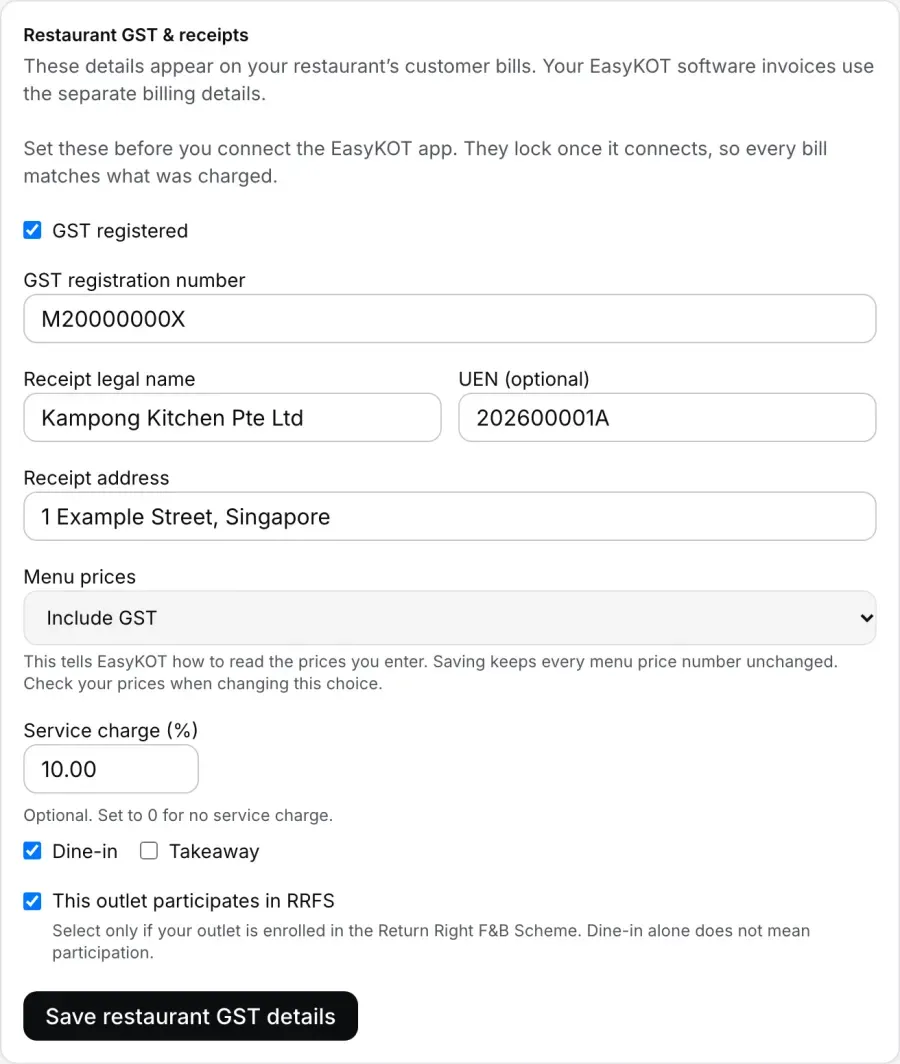
Everything above comes from one settings card in the owner dashboard: whether you are GST-registered, the name, UEN and address printed on receipts, whether menu prices include GST, the service charge and where it applies, and RRFS participation. Fill it in before you connect a register.
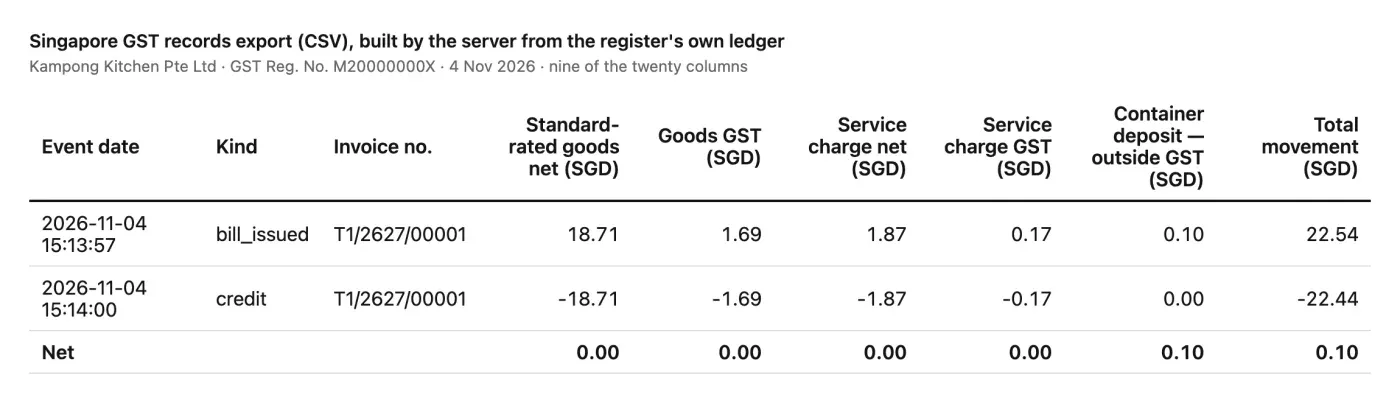
For the GST return, Reports → Sales & collections → Daily sales has a Singapore GST records export, as Excel or CSV. Each bill and each refund is a row, with food, GST, service charge, its GST and the deposit in separate columns. Here is our check and its refund, built by the EasyKOT server from what the register recorded:
What EasyKOT does not do in Singapore yet
- No full tax invoice with the customer’s name and address. Every bill prints as a receipt. A GST-registered business customer whose bill is over S$1,000 needs a full tax invoice; issue that one from your accounting software.
- Not an InvoiceNow-Ready Solution. IRAS is making GST-registered businesses send invoice data through InvoiceNow in phases: businesses registering voluntarily from 1 April 2026 already, existing ones from 1 April 2028 to 1 April 2031 depending on turnover (IRAS: GST InvoiceNow requirement). IRAS lets point-of-sale data be sent in totals; EasyKOT gives you the export, and your accountant or InvoiceNow provider does the sending.
- No GST return filing. The export is for whoever files your GST return; EasyKOT does not file it.
- PayNow and card are marked, not processed. The register offers Cash, PayNow, Card and Part pay. The guest pays your own PayNow or SGQR code, or your bank’s card terminal, and the cashier marks how the money arrived once the bank confirms it. The till does not show a PayNow QR with the amount or talk to the terminal.
- No rounding to 5 cents. IRAS allows a bill to be rounded to the nearest 5 cents for cash; EasyKOT bills to the cent.
- Zero-rated, exempt or out-of-scope items cannot be sold alongside a service charge. With a service charge on, every item is standard-rated at 9%.
What EasyKOT costs in Singapore
The first 3 months are free, with no card. After that it is S$9 a month or S$90 a year, paid once for that period. Nothing renews by itself: you pay again when you want another month or year, and the checkout shows the full amount before you pay. The price is for the restaurant and covers the register, the captain app on Android, the kitchen display and the owner dashboard.
The Singapore setup guide walks through the settings card, the menu and the first check, screen by screen. For what happens when the internet drops mid-service, read billing when the internet is down.
Straight answers.
Can a hawker stall that is not GST-registered use EasyKOT?
Do I charge the 10-cent deposit on drinks my guests finish at the table?
Can my menu show prices before GST and service charge?
Can I change my GST details after I start selling?
Does EasyKOT work without internet in Singapore?
Run it 3 months, then pay for it.
Three months free, full product, no card. Made in India, for the counter: built inside a running restaurant.