Kitchen KOT printer and the cash drawer — set up properly.
Add each printer once in Settings → Printers & KDS, then give it a Role: the counter printer takes Receipt, the kitchen one takes Kitchen (KOT). That is the simple default — three roles, no per-dish rules. Want drinks split from food, on paper? A Kitchen (KOT) printer can also be bound to a station once you set one up. The cash drawer does not plug into the laptop; it plugs into the receipt printer, and it kicks on every settle.
Two printers · one register · KOTs fall back to the bill printer so the kitchen never misses a ticket
The bill printer and the KOT printer do different jobs.
- A KOT is an instruction; a bill is a record. The kitchen ticket carries the table, the round, the dish, the portion and the note — no prices, because nobody at the pass is doing arithmetic.
- They are read in different rooms. One printer means somebody carries every chit to the kitchen. That walk is where the mistakes live on a Saturday night.
- They can want different paper. Paper width is set per printer, so a fat 80mm kitchen roll and a cheap 58mm counter roll coexist happily.
- Start with one, all the same. Role Both is a perfectly respectable setup, and moving to two later changes one dropdown. Connect the first printer if you have not yet.
Add the kitchen printer.
Get the kitchen printer onto the shop network first
The kitchen printer must sit on the same Wi-Fi or switch as the register — EasyKOT refuses an address that is not on your own network. Give it a fixed IP, or reserve one on the router, so it does not move after a power cut.
Open Settings → Printers & KDS and press Set up a new printer
The gear in the register's status rail opens Settings; Printers & KDS is the first section. Set up a new printer walks brand, scan and finish in one flow — or press Detect printers directly if you already know it will find the printer.
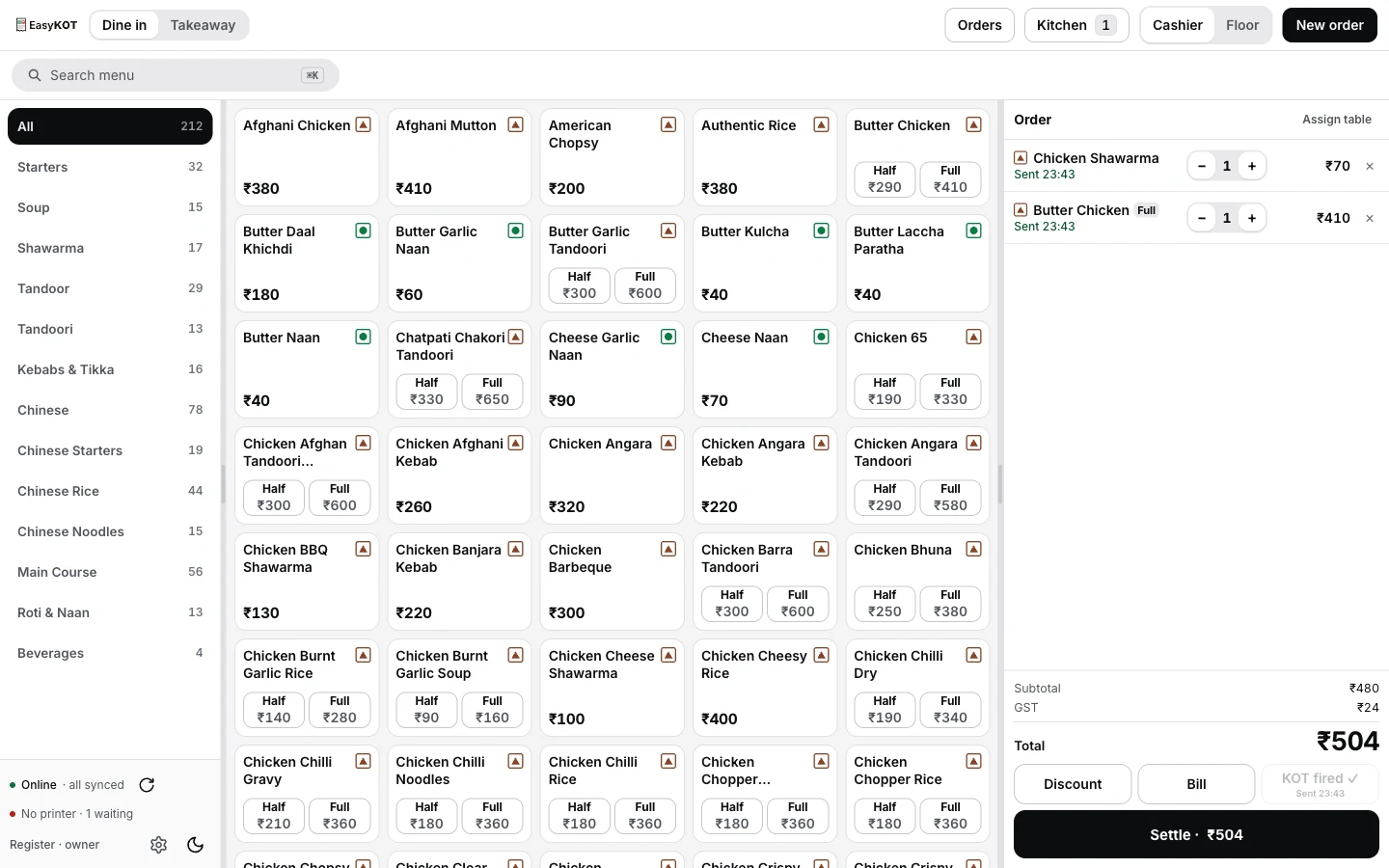
A round on its way to the kitchen — this is what a fired KOT looks like from the till before it ever reaches paper.
Pick the kitchen printer, or add it by hand
Detect scans the network, the USB ports and paired Bluetooth, and lists what it finds with a reason for each row. If it does not turn up, press Add manually, choose Network (Wi-Fi / Ethernet), and type its Printer host / IP with Port 9100 — the raw receipt-printer port every thermal printer listens on.
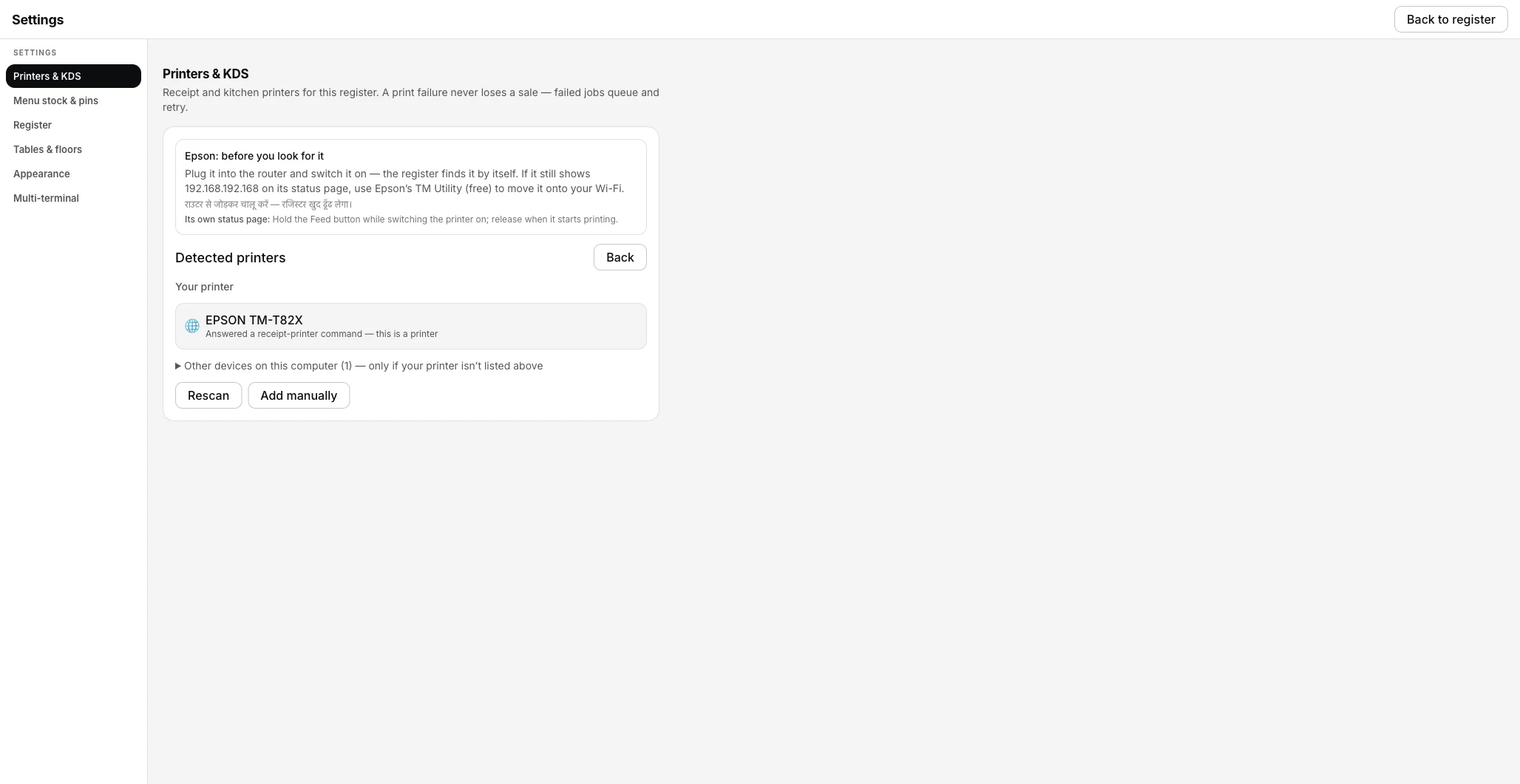
Settings → Printers & KDS → Detect printers — the kitchen printer found on the shop network.
Set Role to Kitchen (KOT), and the paper size to match its roll
Role is the whole of EasyKOT's whole-printer routing: Both, Receipt, or Kitchen (KOT). Choose Kitchen (KOT) and this printer takes the kitchen tickets while your counter printer keeps the bills. Paper size is per printer — the kitchen can run 80mm while the counter runs 58mm, or the other way round.
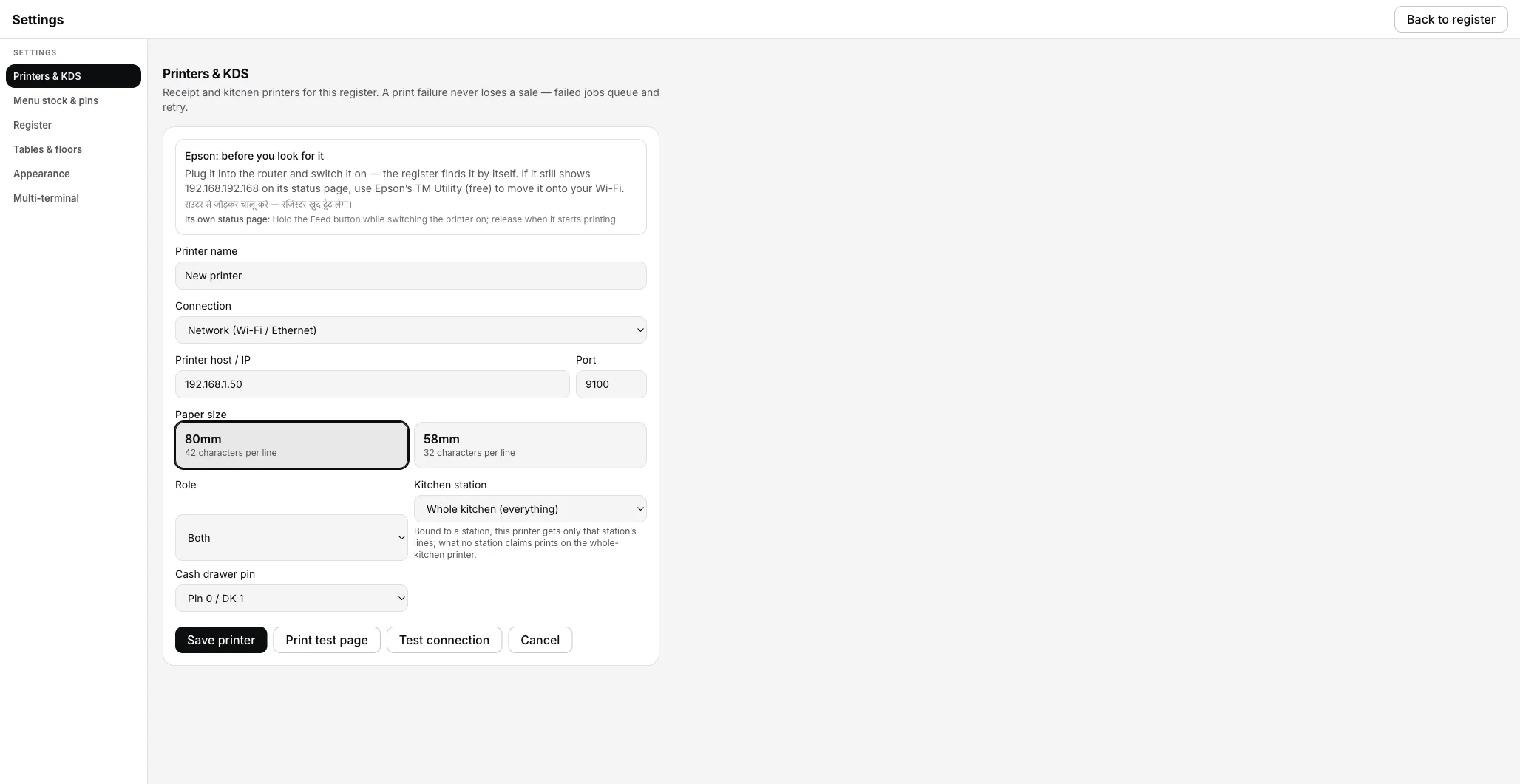
Settings → Printers & KDS → Add manually — host, port 9100, paper size, Role and cash drawer pin in one form.
Set up stations first and a Kitchen station picker appears in this same form — one printer bound to "Tandoor", another left as the whole-kitchen default. See setting up kitchen stations for that step; it is optional, and everything above works without it.
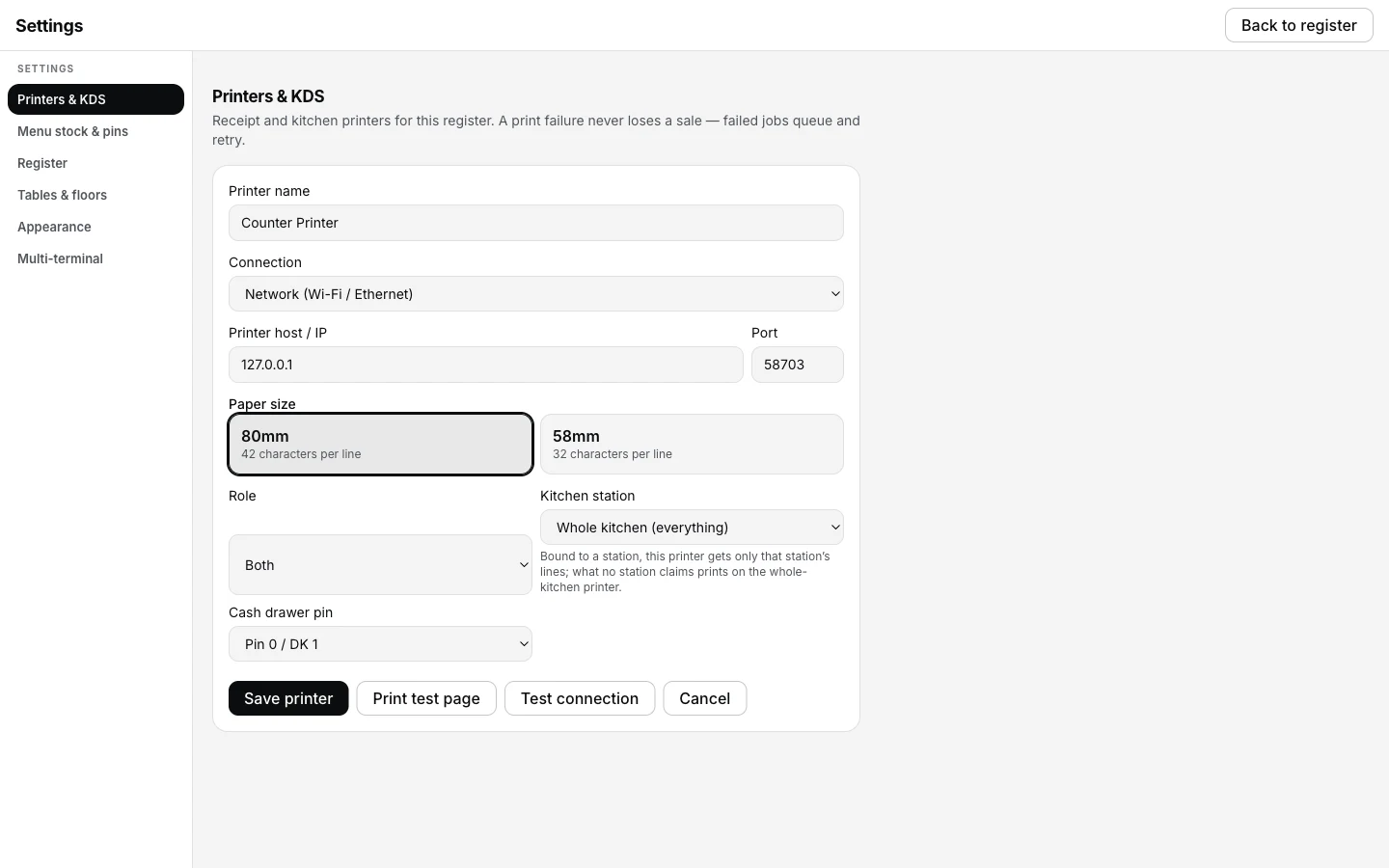
The same edit form, once a store has Kitchen stations set up — the Kitchen station field appears under Role.
Press Print test page, then Save printer — and walk to the kitchen
Do not trust the screen for this one. The test slip prints a digit ruler as wide as the paper you chose; go and look at it at the pass, because the whole point of a kitchen printer is that somebody else reads it.
3 months free · ₹0 today, no card · then ₹299/month or ₹2,990/year + GST for the whole shop
Three roles as the default — one station per printer if you want more.
EasyKOT keeps the default routing deliberately small, because a routing table nobody understands is how tickets go missing. A printer is Both, Receipt, or Kitchen (KOT) — that is the whole model most restaurants ever need.
- Receipt takes customer bills, reprints and the cash-drawer kick.
- Kitchen (KOT) takes kitchen tickets — every one of them, from the register and from a waiter firing a round from a phone alike, unless it is bound to a station (next).
- Both takes everything. This is what a single-printer shop runs.
- No kitchen printer set? KOTs go to the receipt printer. The fallback is deliberate: a ticket landing on the wrong roll is recoverable, a ticket landing nowhere is a dish that never gets cooked.
- Two Kitchen printers, neither bound to a station? The first one saved takes every ticket — EasyKOT does not fan a plain Kitchen (KOT) printer's tickets out to both, or you would cook everything twice.
Drinks to a bar printer, food to the kitchen — on paper. A Kitchen (KOT) printer can bind to one station, and stations are built from your menu's categories in the owner dashboard: tick "Beverages" for the bar station and it prints only drinks, on its own roll, from the same fired round that sends starters to the tandoor printer. Nothing a station does not claim is lost — it prints on the whole-kitchen printer instead. Setting up kitchen stations walks the admin and register sides together.
A kitchen screen does the same split, with no second printer. Put a kitchen display on an old monitor or tablet and tick the categories it cooks — paper keeps working exactly as above alongside it.
What actually prints on a KOT.
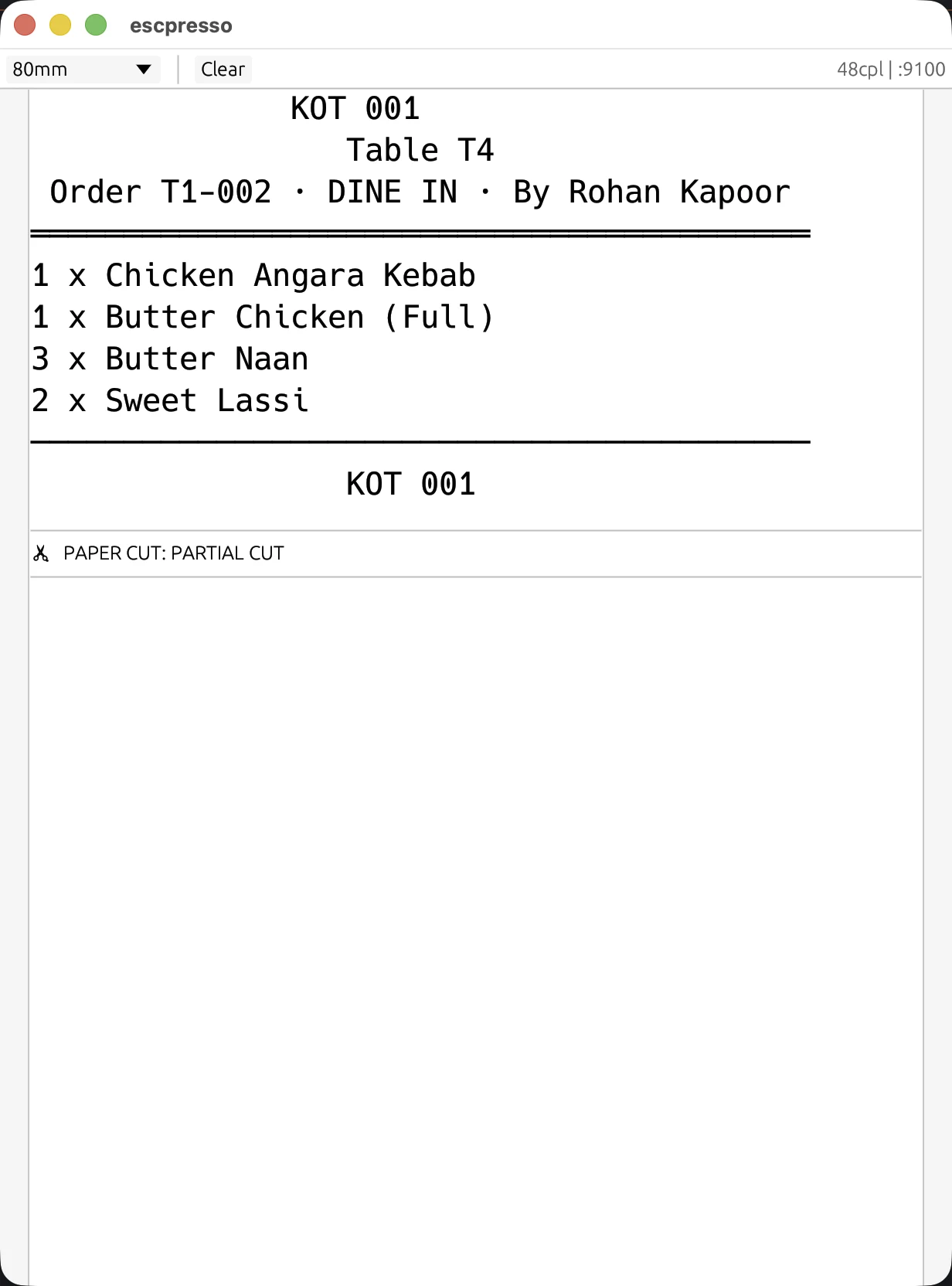
A real kitchen ticket printed by the register, rendered here by a virtual ESC/POS printer — the exact bytes the register sends: table or order handle, dish, quantity, no prices.
- The table, and who sent it. So the pass knows where the plate is going and the floor knows whose round it was.
- The dish, the portion and the quantity. Half and Full are printed as their own thing, not squeezed into the dish name — the difference between a ₹410 plate and a ₹580 one is not something to guess at.
- Add-ons and the cooking note, in bold. "No onions", "mild", "jain" — typed at the table, printed where the cook can actually see it.
- Veg and non-veg marks. Carried through from the menu to the paper.
- The station name, when the printer is bound to one. "KOT 118 · Tandoor" rides the same fire's KOT number — a station never mints its own numbering.
- No prices. A KOT is an instruction to cook, not a document about money. Prices live on the bill.
- Money prints as "Rs." on the bill. The ₹ sign is not in the character sets thermal printers ship with, so a printed bill reads Rs. 480.00 while the screen shows ₹480.00. Deliberate, not a bug.
The second round prints only the new items.
Table 4 orders two starters, then twenty minutes later adds a biryani. The second KOT carries the biryani and nothing else, headed with the round number and how many items went before it — so the kitchen can never cook the starters twice off one table.
- Firing is exactly once. The ticket is acknowledged in the order's own ledger, so even handing the table between terminals cannot reprint history.
- A fired line's quantity can come down, never up. Three waters, one sent back, billed for two — no manager needed. Adding a fourth water opens a new line that rides the next fire, because the kitchen only cooks what a KOT named.
A cancelled dish prints too — the kitchen has to be told.
Removing a dish that a KOT already named is not an edit, it is a write-off: it asks for a manager PIN and a reason, and the record keeps who approved it. On the register the cancelled line stays visible, struck through, because the plate is real until somebody tells the kitchen otherwise.
It plugs into the printer, not the laptop.
A cash drawer is not a device EasyKOT talks to. It is a solenoid on the end of an RJ-11 cable plugged into the receipt printer's DK port, and the printer flicks it open when the register says so. That is why there is no drawer to add and no drawer to connect — only one setting.
- Cash drawer pin: Pin 0 / DK 1 or Pin 1 / DK 2. Which one depends on your drawer and cable. If the first does nothing, try the other — that is the whole troubleshooting procedure.
- It fires on every settle, whatever the tender. Cash, UPI, split — the counter still needs the drawer open for change and for the float.
- A drawer that cannot be queued never costs you the sale. The register says so plainly — the sale is settled, and you can reprint from Orders.

The drawer kick, on the same tape as the bill — proof it rides the receipt printer, not a separate device.
A screen instead of a roll.
An old monitor or a spare tablet on the shop Wi-Fi can show the same tickets — with timers, and a bump button instead of a spike. Nothing to reorder, nothing to run out of at nine on a Saturday.
- Screen and paper are not exclusive. Plenty of kitchens run the display at the pass and keep a printer for the tandoor corner.
- It needs a laptop register hosting it — a phone-only shop prints its tickets rather than displaying them.
- Put the KOTs on a kitchen screen instead — how the display works, and what it costs (nothing extra).
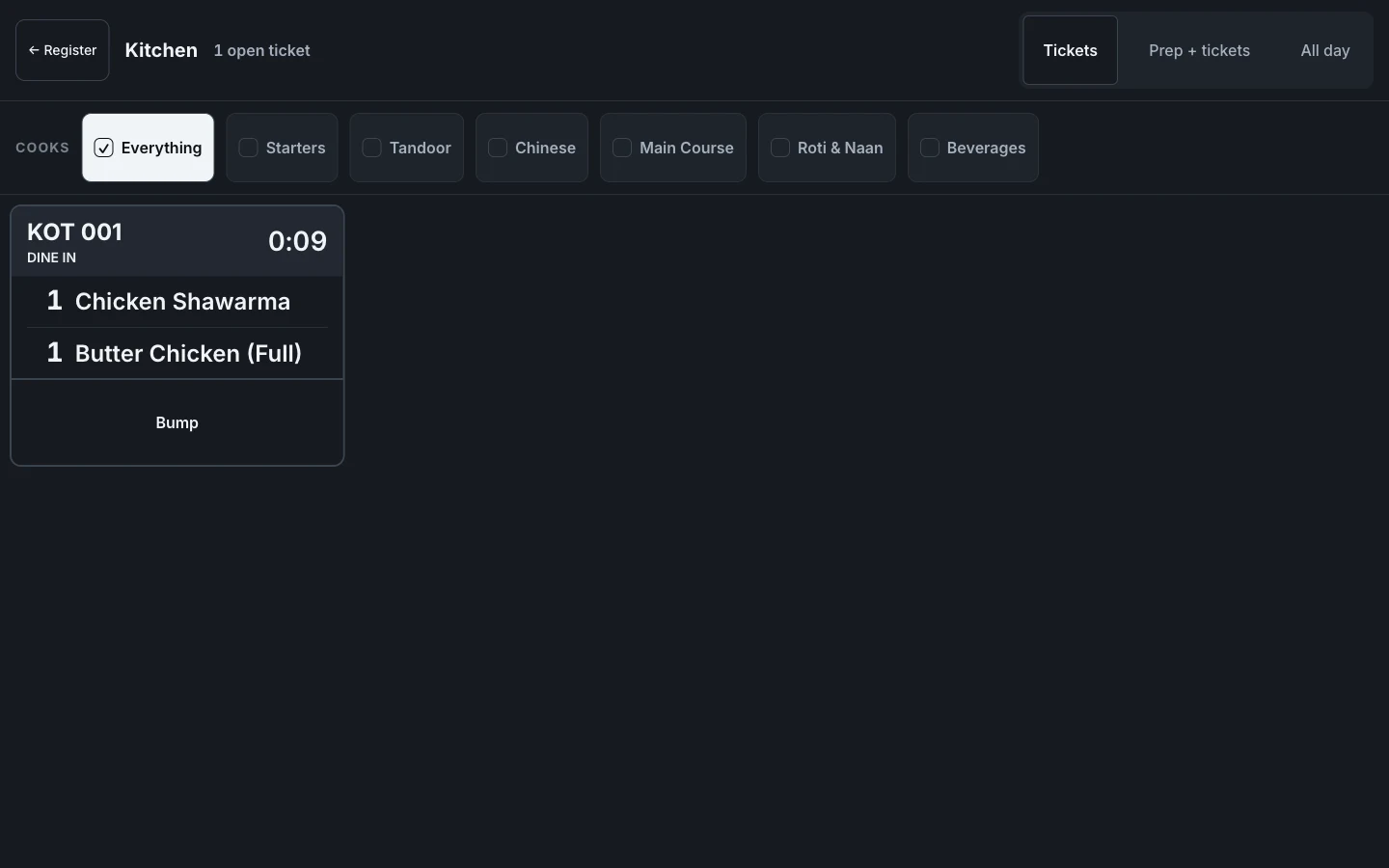
The same fired round, on a kitchen screen instead of paper.
See it before you buy a second printer. The live demo runs the real register in your browser — build a check and fire a round in the demo and you can see the KOT and the matching bill side by side. It needs a laptop, and printing is the one thing a browser cannot do.
A KOT that didn't print is not a lost order.
- The order is written before the ticket is queued. Paper is never allowed to block a sale — the ledger goes down first, the print job second.
- It retries on its own: 1, 2, 5, 15, 30 and 60 seconds, then every minute, up to twelve tries. When it comes back, the queue drains without anybody pressing anything.
- The register tells you, quietly. The status rail shows No printer · N waiting, and Settings shows an N failed pill under Reliability — with Reprint last receipt and Reprint last KOT right beside it. Run Check printer on the kitchen printer's row for the same five-question diagnostic the connect guide walks in full.
- A bill reprint is stamped. Same invoice number, same date, marked as a duplicate copy, with a ledger row recording who asked for it. A KOT reprint is just the ticket again.
Working through a specific symptom? Printer not printing — the five checks, in order covers blank slips, garbage characters, and the KOT that never reached the kitchen. Or read how the register keeps billing when hardware misbehaves.
Straight answers.
Can I use one printer for both bills and KOTs?
Can drinks go to a bar printer and food to the kitchen?
What happens if the kitchen printer runs out of paper mid-rush?
Can I reprint a KOT?
Does the cash drawer need its own cable to the laptop?
Why didn't the drawer open on a UPI payment?
KOT printer aur bill printer alag hone chahiye?
Next: connect the first printer · set up kitchen stations · the kitchen display · all EasyKOT guides
3 mahine chalao, phir paisa lagao.
Three months free, full product, no card. Made in India, for the counter — built inside a running restaurant.