Hafte ka hisaab — sheet nahi, ek page jo aap band karte ho.
Most owners keep the real books in a spreadsheet: one tab a week, sales plus the platform payouts minus expenses, a balance carried from tab to tab, a line for what the partners took. Accounts is that sheet, built in — with the sales, staff pay and expenses already filled in, and the two numbers that matter kept apart: profit, and cash carried forward.
Sunday raat ka routine, char steps mein.
Start a period with the cash you have
Open Accounts. The first time, it asks two things: the day your period starts, and how much cash the business has in hand right now. That is the opening balance. Every period after this one starts the day after the last and opens with whatever the last one closed on — the running balance your sheet carried from tab to tab, done for you. Periods default to a week; move any open period's end date if you count on a Tuesday this time.
Type the two things the register can't know
Sales, staff pay and every logged expense arrive on their own. Two things only you know: what Swiggy, Zomato or your local platform actually paid you this period — add them under Money in, one line per platform, on the day the money landed — and what the owners took out. A withdrawal, a profit share, a capital repayment or fresh capital is recorded under Taken out, optionally per partner. None of it is ever an expense, so your profit stays honest.
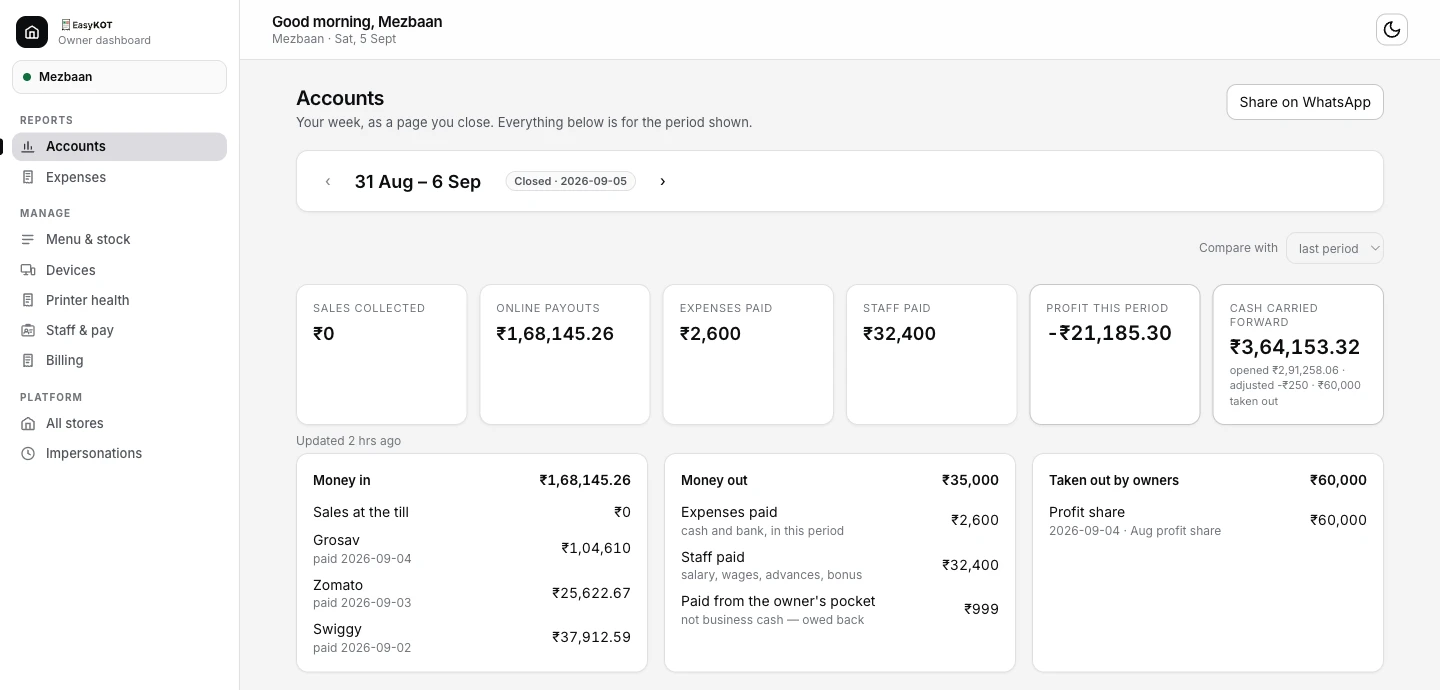
Step 2 — the two things only you know, typed under Money in and Taken out (shown here after the week was closed).
Read the six numbers, then close
Sales collected, online payouts, expenses paid, staff paid, profit this period, and the one that matters most: cash carried forward — opened with, ended with. Each shows how it moved against the previous period, or against any period you name: compare Ramzan with last Ramzan, not with the week before. Write a note when the week needs one — "Ramzaan", "price increase", "closed 3 days". Then Close. The numbers freeze as the record, the next period opens with the carried-forward cash, and the same six lines go to everyone on the dashboard by email — or to your partner on WhatsApp with one tap.
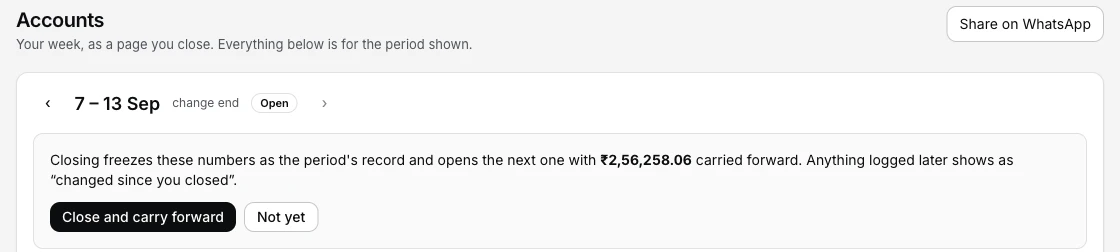
Step 3 — Close names the carry-forward before it freezes anything.
Zoom out when you need to
Every report — Summary, Sales, Menu, Profit & loss, Expenses, Labour — sits inside the period as a tab, already set to its dates. All periods lists them like the tabs of your workbook. Year lays the months down the side with sales, expenses, profit and your notes beside them. Partners shows each partner's capital put in, repaid, still owed, taken out and profit share — the investment and profit-sharing tabs, live.
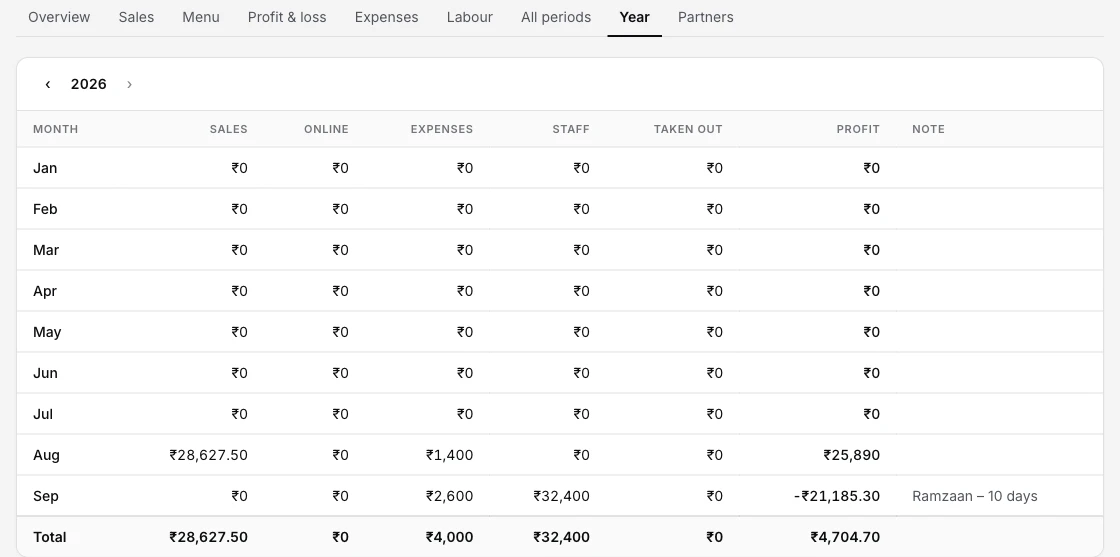
Step 4 — the year, with the notes that explain the dips.
Your own words, your own platforms: dashboard → Settings → Accounts. Say how long a period usually is, switch online payouts on and name who pays you — Swiggy, Zomato, a local service — and rename any expense category to what you actually call it, pinning the daily ones so they come first.
Straight answers.
Profit and cash carried forward — why two numbers?
What counts as money out?
Period band karne ke baad koi bill aa gaya toh?
When does a Swiggy or Zomato payout count?
Do I have to set up partners?
Where does the email go, and can I turn it off?
Where the numbers come from.
Reports & the morning email
The six reports that now live inside each period, and the daily email that arrives before you open any of them.
Read your numbers →Staff & pay
Set each person's pay, give advances, and pay salary net of them — the staff line on every period.
Set up pay →Closing the day
Clean checks in, clean numbers out — the one-minute night routine the week is built from.
Close the day →Every guide in this cluster is listed on the guides hub.
3 mahine chalao, phir paisa lagao.
Three months free, full product, no card. Made in India, for the counter — built inside a running restaurant.