Close the day clean — no check left hanging.
Every restaurant ends the night with strays — the table that was opened by mistake, the group that vanished before paying, the check someone settled in cash and never closed out. The register sorts them into three buckets with three different rules, and shows your GST invoice series while you're there. One minute, and tomorrow starts clean.
Yesterday's leftovers to a clean slate — three steps.
Open Day close from the Orders screen
On the register, open Orders and press 'Day close' in the header. If checks are hanging over from a previous trading day, the screen has already been telling you — a leftover banner with a 'Close them out' key appears on its own. Either way you land on the same sheet.

Step 1 — Day close lives on the Orders screen, one key, always there.
Sort the leftovers — the sheet has already grouped them
Every stale open check lands in one of three buckets. 'Nothing rung' is the mis-taps — tables opened, nothing ordered; one tap discards them all, no PIN needed. 'Never paid' is rung food with no money collected — write those off together with a typed reason and a manager or owner PIN, so written-off food is always a signed decision. 'Money already taken' gets no bulk key on purpose: money is involved, so each one is settled or refunded individually.
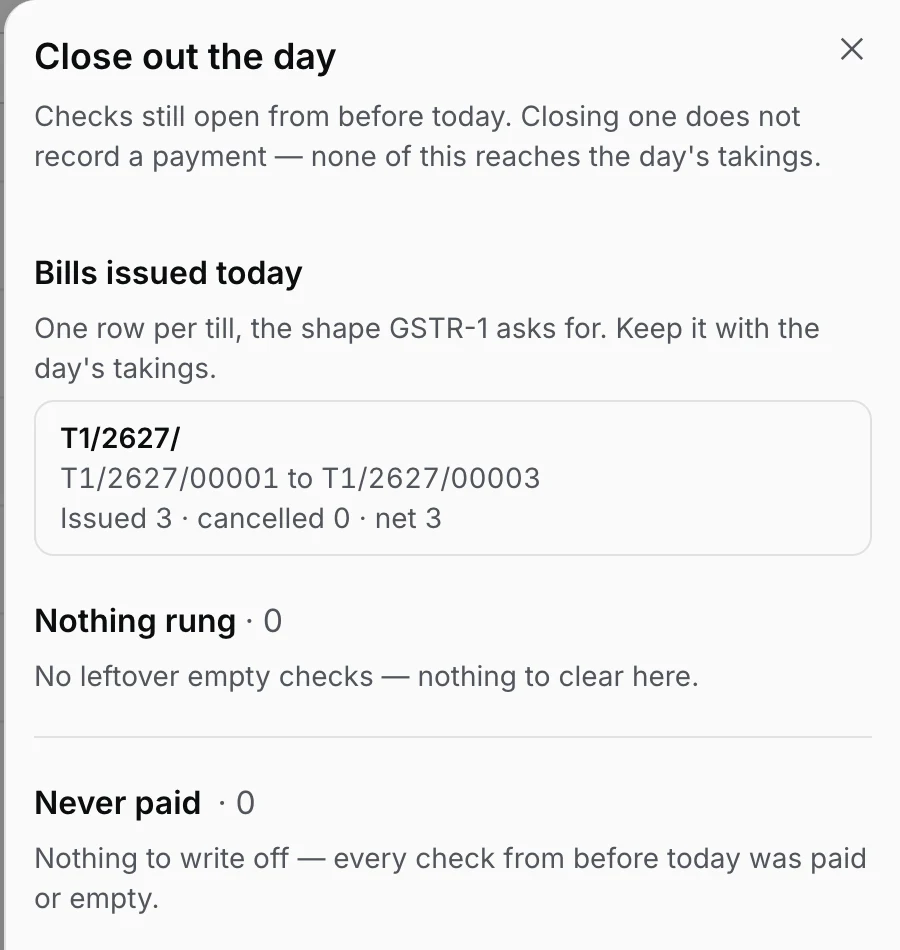
Step 2 — a clean close: three bills issued in an unbroken series, no strays to sort.
Read 'Bills issued today' before you leave
The same sheet shows the day's invoice series — 'Bills issued today', one row per till in the shape GSTR-1 asks for: the number range, how many were issued, how many cancelled, the net. Thirty seconds here is what makes the accountant's month painless: a gap you can explain today is an afternoon you don't lose at audit.
Three buckets, three rules — on purpose.
- Empty checks cost nothing, so they cost nothing to clear. A mis-tap has no food and no money on it — "Discard N empty checks" is one tap, no PIN, no reason. Friction here would just teach staff to leave them.
- Written-off food is a signed decision. A never-paid check is a loss — maybe a walkout, maybe a comp nobody recorded. The register takes a typed reason and a manager or owner PIN before food comes off the books, and keeps both. The same rule that guards a fired-line void during service guards the end of the night.
- Money never gets a bulk key. A check that took a payment and stayed open is an inconsistency worth thirty seconds of attention each — settle it properly or refund it properly. Bulk-clearing money is how registers hide problems; this one refuses.
- The trading day is yours. "Stale" is measured against your day's start — 4:00 AM by default, adjustable in the dashboard — so the 1 AM biryani order is tonight's sale everywhere: on this sheet, on the KOT counter, and on the report your accountant reads.
Running the whole shop from a phone? The phone register adds the actual cash-box ritual — opening float, cash in and out, the count, and the variance at close. A full day on one phone walks it end to end.
Straight answers.
Does Day close record my cash or takings?
What's the difference between discarding and writing off?
When does the day actually end — midnight or morning?
What about counting the cash box — float, paid-outs, variance?
Do I have to run Day close every night?
The rest of the routine.
Your first GST bill
Where those invoice numbers come from — the series, the late minting, and why gaps matter.
See the billing walkthrough →Staff PINs & roles
The manager PIN that signs a write-off — and everything else each role can and cannot do.
Set up staff →Billing with the internet down
Why none of this ever waits on the network — the register closes a day offline too.
See the outage walkthrough →Every guide in this cluster is listed on the guides hub.
Run it 3 months, then pay for it.
Three months free, full product, no card. Made in India, for the counter — built inside a running restaurant.