Pehla order se pehla GST bill — chaar steps.
Punch the dishes, fire the KOT, settle the table, print. The register puts your outlet name, GSTIN, item lines, CGST, SGST and the round-off on the slip by itself — you set the tax slab once in your dashboard, on your CA's advice. The bill prints whether or not the internet is up.
No printer yet, no account yet? Do all four steps right now in the live demo — it runs the real register in your browser, on a laptop-size screen.
Three settings that must be right.
- Your invoice identity. In the owner dashboard, under Settings, fill in GSTIN, Address, State and State code. This is the supplier block that has to sit at the top of a tax invoice.
- Whether you charge GST at all. One switch in the same Settings page. On, and the register reads "charging GST at each item's slab". Off, and dishes ring at their menu price with no tax line on the paper — the right answer for a shop that is not registered.
- A GST slab on each dish. Every item in your menu carries a GST slab — pick the tax you created, or "No tax". Get the menu imported first and this is a one-column pass, not 300 forms.
The one that bites. With GST switched on and the GSTIN box still empty, the register will happily print — and the slip is not a valid tax invoice. Fill the identity fields before the first real guest, not after.
Not set up yet? The five signup steps come first, and the thermal printer connects in about two minutes.
Order se printed slip tak — four steps.
Punch the order
Open a table or tap Parcel for takeaway, then tap the dishes. Search or use the category rail, pick Half or Full where the dish has portions, and add a line note like 'no onions' or 'less spicy'. Tap the same dish again and the quantity on that line goes up — you are not building a second line.
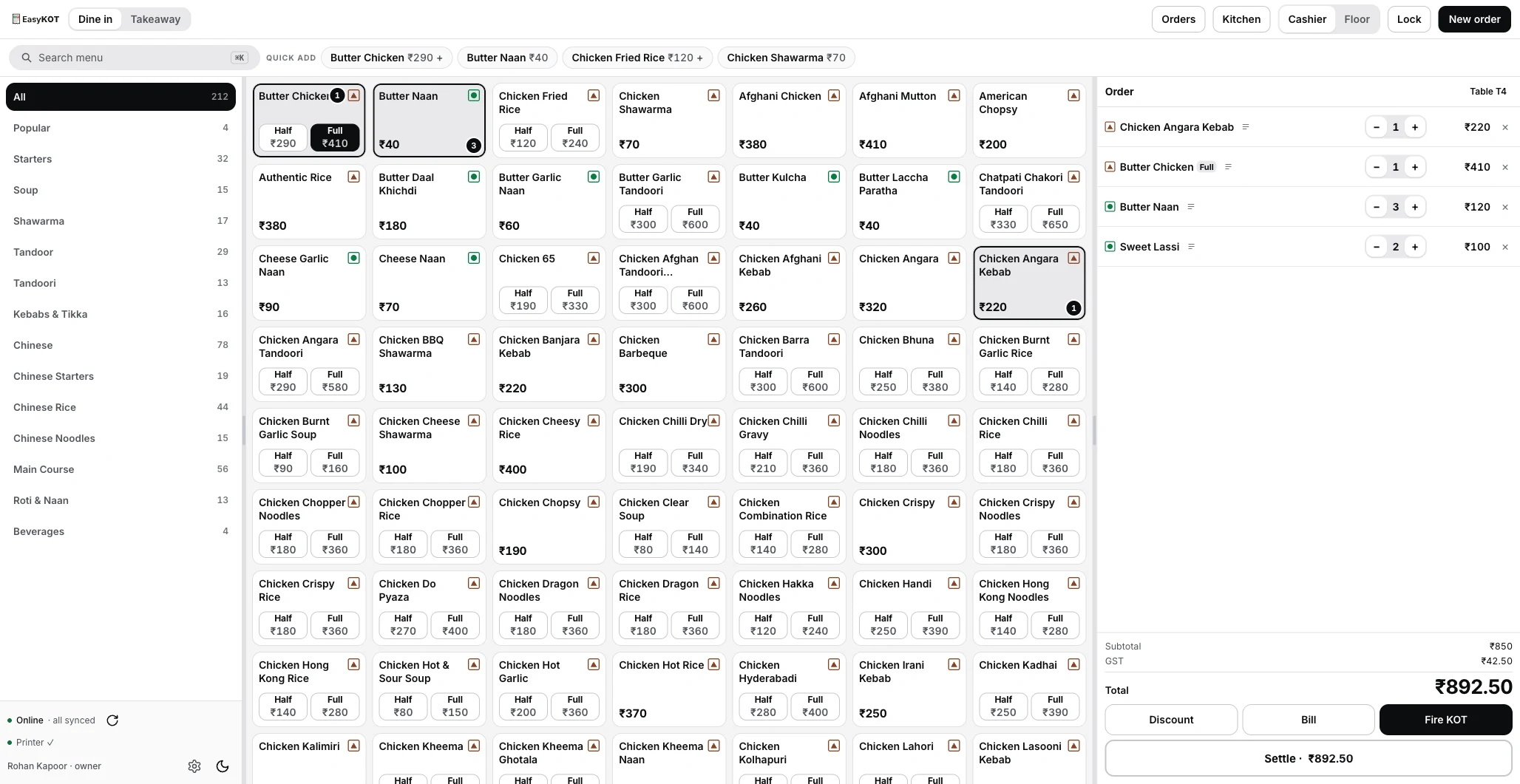
Step 1 — tap the dishes; the cart on the right builds as you go.
Fire the KOT
Press Fire KOT. The kitchen ticket goes to the kitchen printer — or to the kitchen screen — and the key changes to 'KOT fired ✓' with the time it was sent. Those lines are now locked to this table's bill. Order more later and the next KOT carries only the new items, so nothing cooks twice.
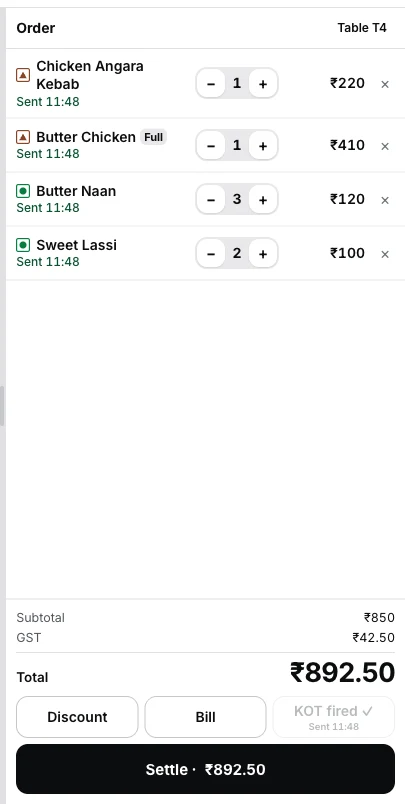
Step 2 — fired lines lock to the bill and the key reads “KOT fired ✓”.
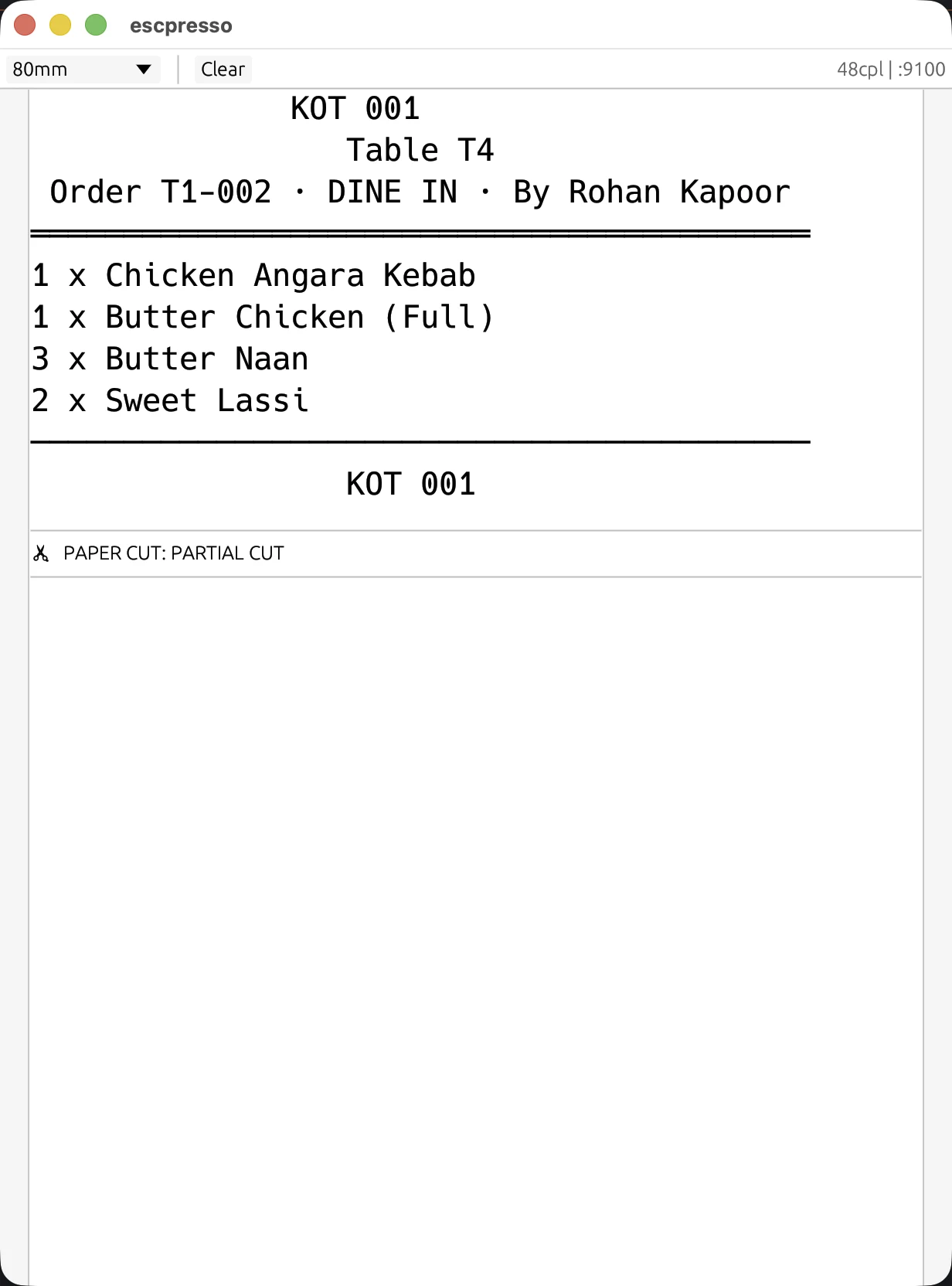
What actually comes off the kitchen printer when you fire — no prices, only what to cook. Rendered here by a virtual ESC/POS printer, the exact bytes the register sends.
Settle — cash, UPI, card or part payment
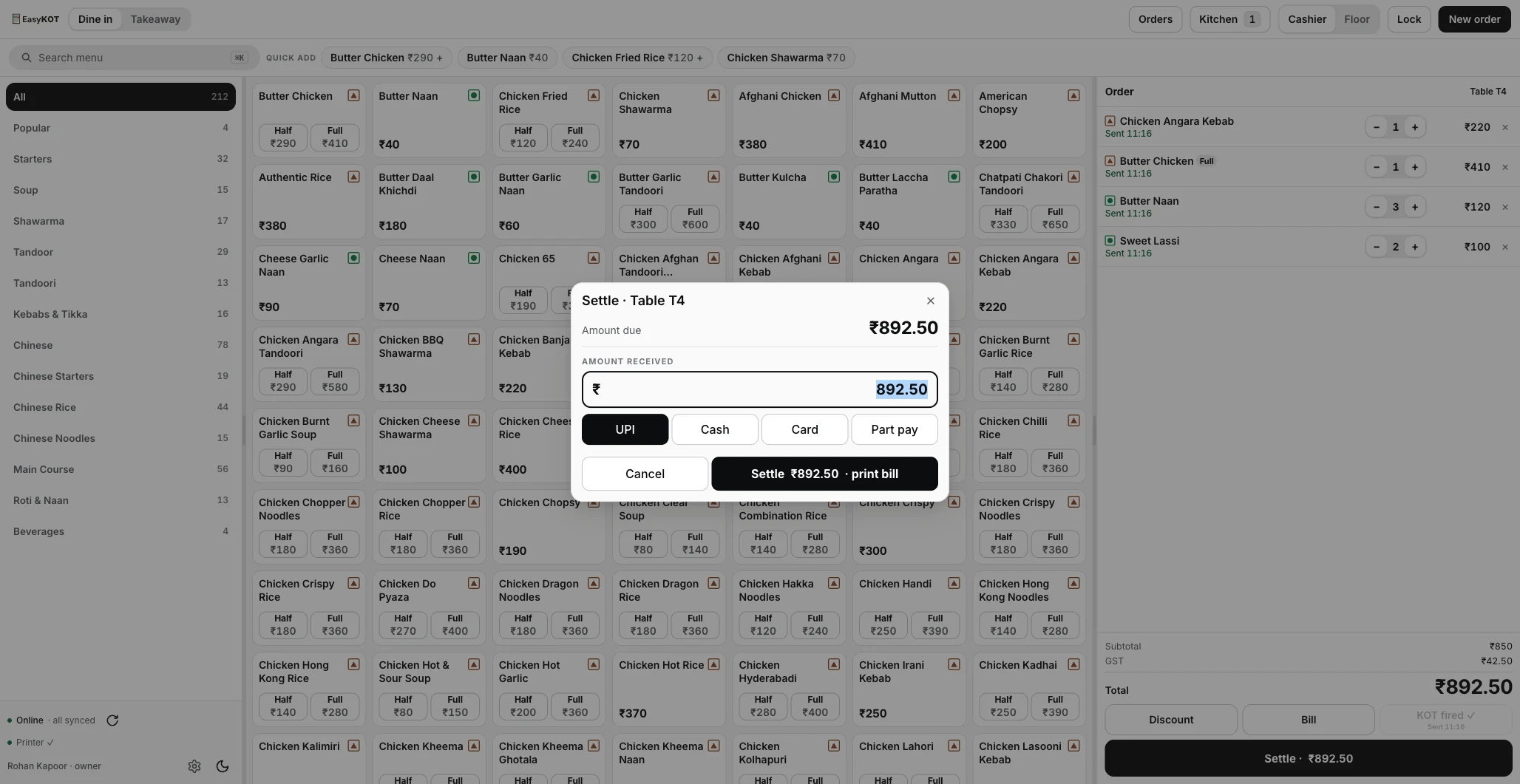
Press the Settle key. Type what the guest handed over in 'Amount received', pick the tender — UPI, Cash or Card — and the register works out the change. Use Part pay when the table splits it. The cash drawer kicks open on the settle.
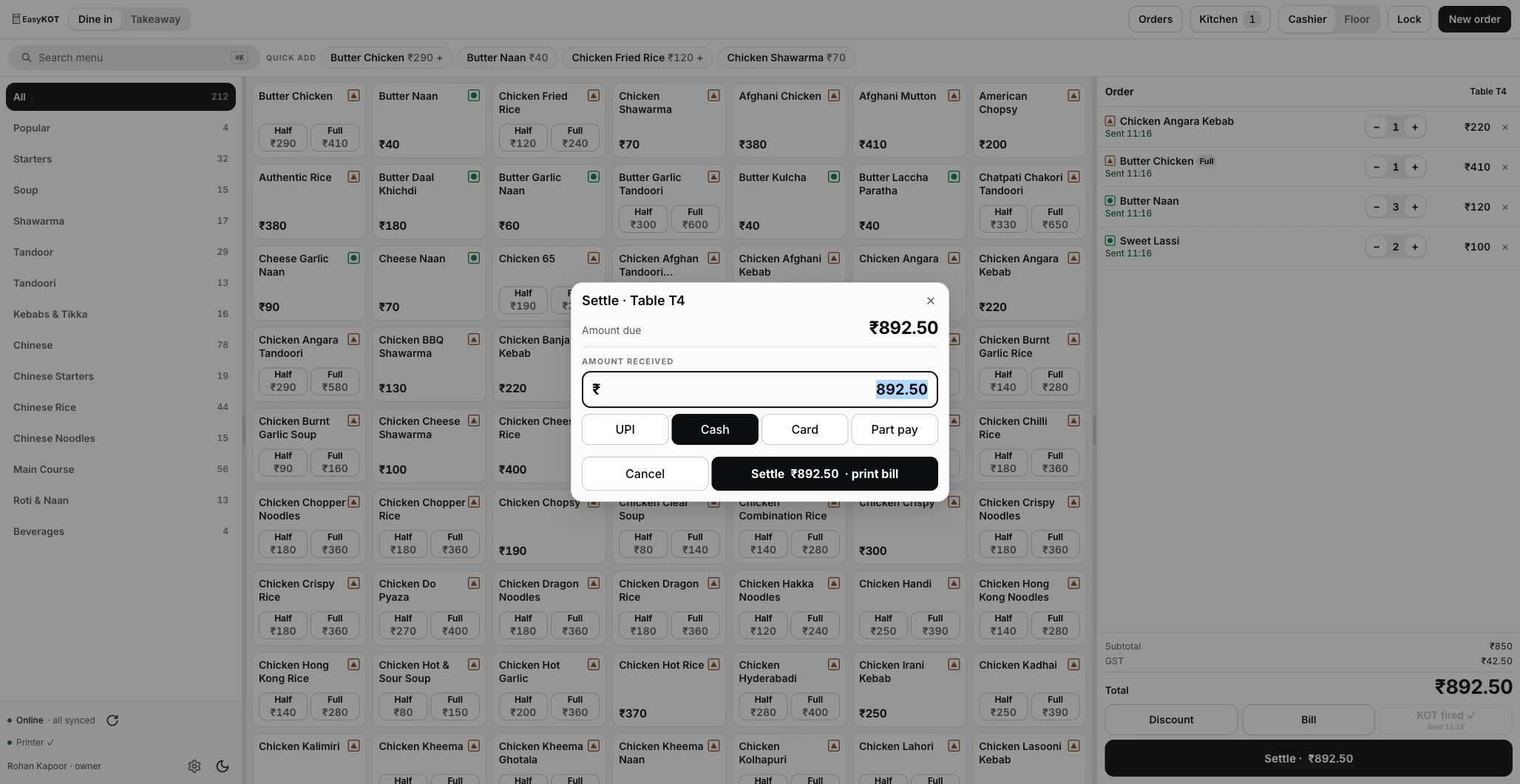
Step 3 — type what the guest handed over; here it matches the bill exactly, so there is no change to return.
The bill prints
Settling queues the printed bill straight away: your store name, GSTIN, address and state, a GST invoice number and its date, every item line, CGST and SGST on separate lines, round-off, the total and how it was paid. Guest wants the bill before paying? Press Bill first — that prints what is owed and mints the same legal invoice number, and it also tells the floor this table is waiting to pay.
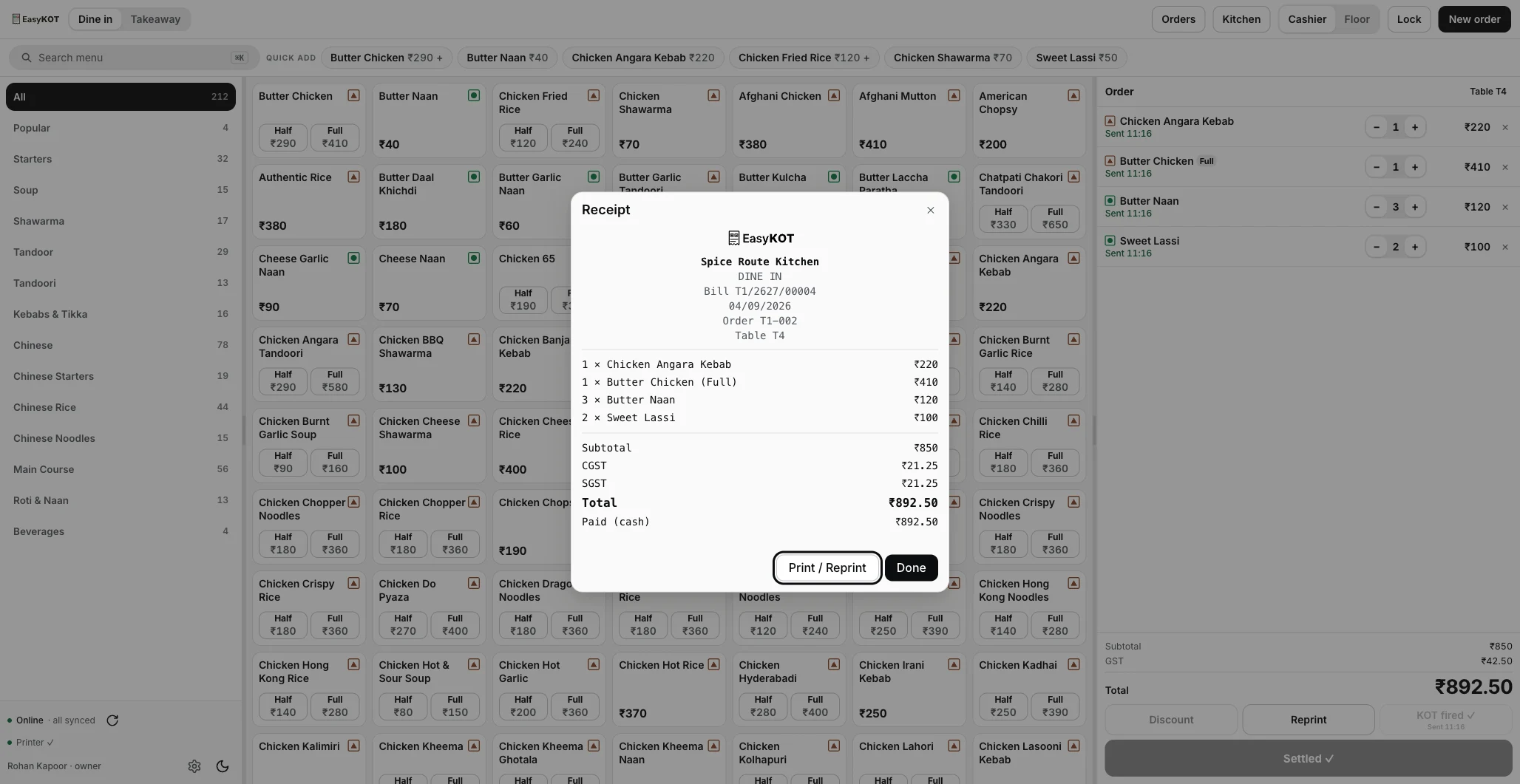
Step 4 — the receipt is ready; Print / Reprint sends it to the printer, exactly as it reads here.
Or rehearse it with nothing installed: the live demo runs the same four steps in your browser.
What comes out, line by line.
- The header. Your outlet name, then the supplier block — GSTIN, address, state and state code, exactly as you typed them in the dashboard.
- The document line. The GST invoice number and the date it was issued. That date is pinned when the number is minted, so a reprint in March still shows the day the bill was made.
- The order line. Dine-in or parcel, the table, and the short handle staff say out loud — T1-042, the one a guest can quote before a bill exists.
- The items. Quantity, dish, portion folded into the name ("Chicken Manchurian (Half)"), any add-ons, and the line amount.
- The tax block. Subtotal, then CGST and SGST on separate lines — an intra-state bill splits the tax in half, and any odd paise goes to CGST so the two always add back to the total exactly.
- Round-off and total, then what was paid and by which tender. The round-off line only prints when there is one.
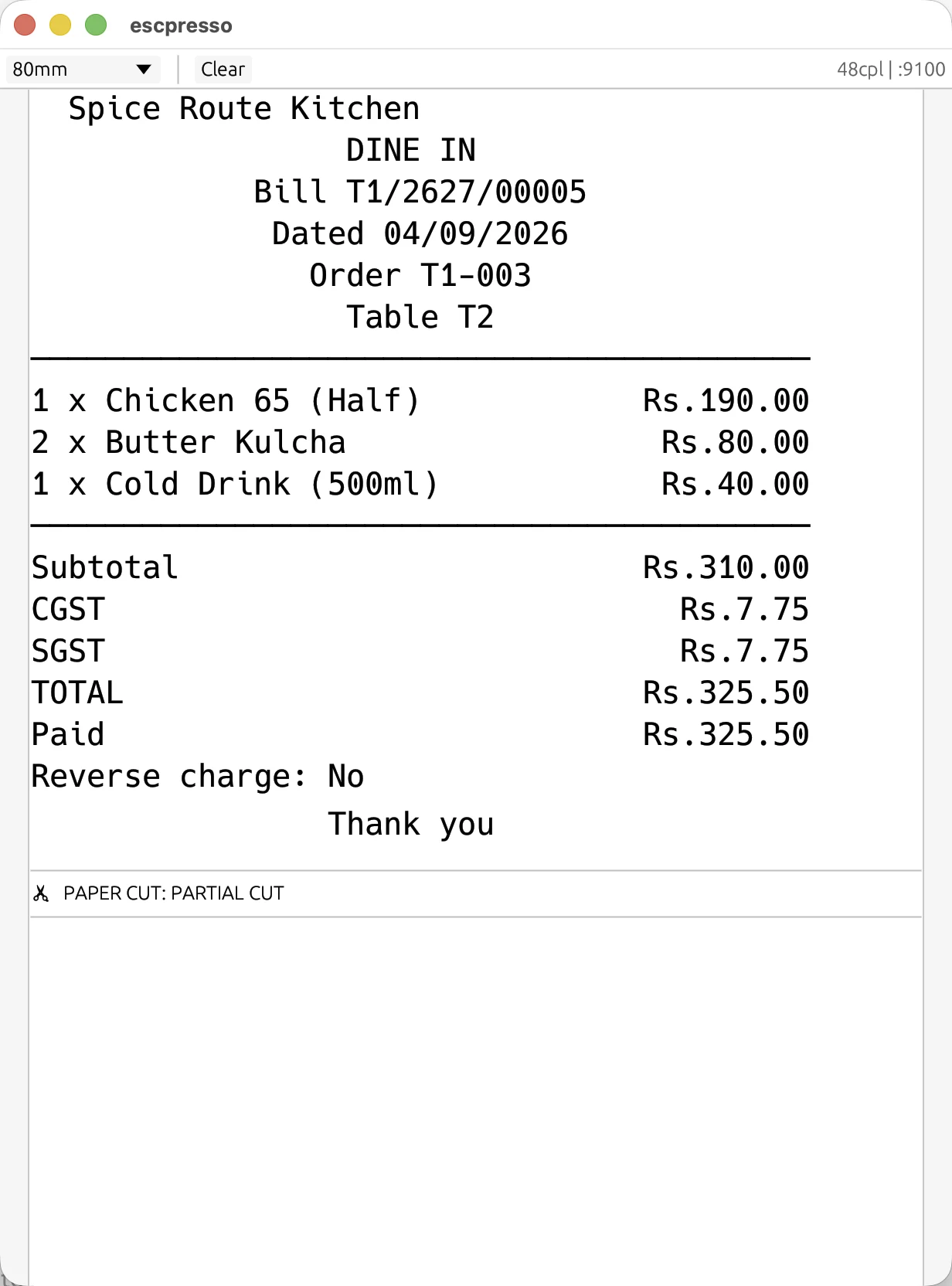
Every line above, on the actual slip — CGST and SGST split in half, the invoice number and date, the total. Rendered by a virtual ESC/POS printer, the exact bytes the register sends.
Why the slip says "Rs." and not "₹". The rupee glyph does not exist in the character sets thermal printers use, so amounts print as Rs. 913.50. That is deliberate, and it is what stops a bill coming out full of question marks on a cheap printer. On the register's own screen the amounts still show ₹.
80 mm paper gives you 42 characters a line, 58 mm gives 32 — the width you pick in printer setup changes the layout, not just a label.
Your CA picks it. We only carry it.
EasyKOT is a billing register, not a tax adviser — so we do not publish rates and we do not pick one for your outlet. What the software guarantees is that whatever slab you set is the slab that reaches the paper, on every sale, every till.
- You create the tax once in the dashboard and attach it to dishes as their GST slab. Different slabs on different items is normal and fully supported.
- The rate is frozen onto the sale at the moment the item is rung up. Change a slab next month and last month's bills and reports keep the tax that was actually charged — nothing is rewritten behind you.
- Not registered? Switch GST off. The bill then prints with no tax line at all, which is the honest document for a shop under the threshold.
- Ask your CA which slab your outlet falls under before the first bill. It takes one message, and it is the one thing on this page we cannot answer for you.
One series per till. No holes.
- The number looks like T1/2627/00001 — the till, the financial year, and a consecutive count that resets on 1 April. Sixteen characters, inside what Rule 46 allows.
- It is minted late — when you press Bill or Settle, not when the table opens. A table that walks out without ordering never burns a legal number, and an unexplained gap in the series is exactly the thing that costs you an afternoon at audit.
- Two tills run two series and each stays internally consecutive, which is why a second counter can keep billing through an outage with no coordination at all. Billing with the internet down covers what else keeps running.
- A reprint is stamped DUPLICATE with its copy number and keeps the original number and date. The kitchen's copy works the other way round — a reprinted KOT is the same ticket again, because the pass wants the ticket, not a reissue.
If the printer is dead when you settle, the sale still stands. Settling writes the ledger first and the paper second: the ticket waits in a queue, retries by itself, and prints when the printer is back — or you press "Reprint last receipt" in Settings. A print failure has never lost a sale.
Straight answers.
Does EasyKOT print a GST-compliant tax invoice?
Which GST rate should my restaurant use?
Can I print a bill if I am not GST-registered?
Can I reprint a bill after the guest has left?
Do bill numbers stay continuous if I bill offline?
Can I send the bill on WhatsApp instead of printing it?
Pehla bill banane mein kitna time lagta hai?
After the first bill.
Connect a thermal printer
Wi-Fi, USB or serial — find it, pick 58 mm or 80 mm, and run the test print before service.
Connect the printer →Kitchen KOT printer
Add a second printer for the kitchen so bills stay on the counter and tickets go to the pass.
Set up the KOT printer →Billing with the internet down
What keeps working at 8:40 pm when the fibre dies, and where those bills go until it comes back.
See the outage walkthrough →The register itself is described on the billing register page, and every guide in this cluster is listed on the guides hub.
3 mahine chalao, phir paisa lagao.
Three months free, full product, no card. Made in India, for the counter — built inside a running restaurant.